Monday, 11 May 2020

Eastbourne Borough


Eastbourne Borough FC is a non-league football club from the south coast town of the same name, who were founded as Langney FC in 1964, after the district in which the club played. Langey joined the Eastbourne & District Football League, where they were given a place in Division Two.

In the summer of 1968, the club changed its title to Langney Sports FC as they continued to play on local recreation grounds before moving to Princes Park, which was located next door to Eastbourne United’s Oval home.


In 1973-74, Langney won promotion to the local Premier Division before advancing once more in 1983 as the club was elected as a founding member of Division Three of the Sussex County League.

At the same time, Sports moved from Princes Park to a new home ground on Priory Lane, right in the heart of the Langney community. In 1986-87, the club won the Division Three title along with two cup competitions. A second successive promotion was achieved in the following campaign from Division Two.


Pete Cherry, who had managed the club all the way through from local football, departed to be replaced by Steve Richardson and then Garry Wilson in 1999 as the club continued to finish in the top four of Division One of the Sussex County League.

Sports lifted the league title in 1999-00 and were promoted to the Southern League Eastern Division, where the club consolidated its position. On the 26th May 2001, the club changed their name to Eastbourne Borough FC.


Borough finished as runners-up in the Eastern Division of 2002-03, winning promotion to the Premier Division. During the period, Sports lifted the Sussex Senior Cup and were beaten finalists on one occasion.

An eleventh-place finish in 2003-04 was enough to clinch Borough a place in the newly formed Conference South for the following season as non-league football was re-organised during the summer of 2004.


The club's debut season at the new level also ended in drama. After a fifth-place finish, Borough defeated Thurrock and Cambridge City in the play-offs to face Altrincham for a place in the non-league top flight. The team went down 2-1 in the final at Stoke’s Britannia Stadium.

The 2005-06 campaign saw the club reach Round One of the FA Cup for the first time. A draw against League Two Oxford United at Priory Lane was achieved before Borough went down in a replay at the Kassam Stadium.


The league season ended with a mid-table berth, while a seventeenth-place ending in 2006-07 also saw Round One Cup action. This time, Borough went out to Weymouth. The same stage was reached once more the following season, ending with a loss to Barrow after a replay.

However, Borough finished runners-up of Conference South in 2007-08 and were promoted to the Conference following victories in the play-offs over Braintree Town and then Hampton and Richmond Borough at Stevenage.


All the time, the facilities at Priory Lane were being upgraded to match the club's status. Their inaugural season saw the team finish in mid-table as a part-time club up against many full-time outfits.

A victory on the final day of the 2009-10 season, by courtesy of a late penalty against Oxford United, saved the side from relegation. Borough’s third season in the Conference, 2010-11, ended in relegation back to Conference South.


However, some solace came as the club competed in the first-ever game at Brighton & Hove Albion’s new Amex Stadium, going down 2-0 to an Albion side in the final of the Sussex Senior Cup. In January 2012, the club dispensed with Garry Wilson, their manager of thirteen years. The former Southampton midfielder Tommy Widdrington came in as his replacement as the season ended with Borough in twelfth position.

Widdrington rebuilt the squad as the club introduced an academy, and the Chairman of forty years, Len Smith, stood down. Mid-table finishes continued, although a third Sussex Senior Cup was added to the club's list of honours.


In the summer of 2016, the pitch at Priory Lane was changed to an artificial FieldTurf surface to allow for more club and community use. Widdrington departed in April 2017 to take up a post at Coventry City, with Bognor Regis Town boss Jamie Howell arriving to take up the helm at Borough.

Howell departed in February 2019, with Mark McGhee helping the side over the line to avoid relegation before the appointment of Lee Bradbury, who lasted a matter of months before Danny Bloor was given the role of manager. In 2021-22, the Sports reached the playoffs, where they lost their semifinal tie to Oxford City.

New owners arrived in June 2023, installing Mark Beard as manager, lasting until the midway point of the season when Adam Murray took charge, and the team put together a fine run to eventually finish above the drop zone. He then led the team to the playoffs in 2024-25, which ended in a semifinal defeat to Maidstone United. Matt Gray succeeded Murray in May 2025.

Former boss Widdrington returned to the post in October 2025 before being replaced by Steve King a few months later. Borough were relegated to the Premier Division of the Isthmian League at the end of the season.

Eastbourne Borough FC will play in the Isthmian League Premier Division in the 2026-27 season.

My visits

Tuesday 12th December 2007


With a day off from work, I decided to head down to the south coast on a cool but sunny day to explore some new places and visit some non-league football clubs. I certainly got plenty of exercise!

After stopping off at Lewes, Eastbourne was my second town on the list. A look at Eastbourne Town’s Saffrons ground was followed by a walk along the prom to Eastbourne United Association’s Oval. By then, I needed a bit of a rest, so I let a bus take the strain.


Unable to find a nearby stop, I headed to the Tesco Express and then took the service, which dropped me off at Shelley Avenue, close to the ground. The Priory Lane Stadium was locked up, but I still got a decent look through some gaps in the fences.

It was apparent that Borough had built the ground gradually and had a fine non-league football ground offering plenty of cover for spectators. There was also a training pitch on the approach to the entrances.


Once I’d taken my snaps, I embarked on a longer-than-expected walk, along Priory Road, which turned into a B road as I headed into the country; eventually reaching the pretty village of Pevensey over a mile away to catch a train further down the coast at Pevensey & Westham station.

Eastbourne Borough 1 Dagenham & Redbridge 2 (Monday 24th July 2017) Pre-Season Friendly (att: 319)


While the match at Priory Lane had been pencilled in for a couple of weeks, I’d made the most of my day off work and visited the grounds of Seaford Town, Newhaven, Peacehaven & Telscombe, Bexhill United, and Eastbourne United Association as well as walking many miles.

With a bit of downtime before the match, I sought out two pubs on Seaside. The Arlington Arms was very much a locals' pub with a decent pint of Harvey’s Bitter. The juke box wasn’t too inspiring and rather loud, so I decided to give the Alexandra Arms over the road a go.


I’d made an error. The pint of Tribute was satisfactory, but a gaggle of local lads had obviously downed tools very early and were louder than the music over the road. I wasn’t too upset when it was time for the bus to the match.

The Loop service dropped me at the Shelley Walk stop, just a couple of minutes from the ground. I poked my head in the clubhouse, but decided to go straight to the ground. Admission was £8, a programme £1, with teamsheets being issued free.


It was time for food. Only one of the three hatches was open for the night. I purchased a cheeseburger with onions, chips, and a tea for £6.30. It wasn’t bad fare and filled me for the price. The staff had been most pleasant. I headed to the Main Stand to enjoy it.

Priory Lane wasn’t quite as vast as I’d thought from my previous visit, but it was still a very decent venue for a club of Borough’s size. I noted the inscription ‘Langney Sports’ was still on the wall backing the open section of terracing.


The Main Stand was all seated. Surprisingly, it didn’t have a wall next to the pitch. Fans simply walked along next to the artificial surface to find their aisle. The covered terracing snaked right round two and a bit sides.

The players’ facilities and club shop were behind a covered terracing at the entrance end. Borough had cleverly built an extra storey, which doubled up as corporate boxes looking out over the pitch.


Before kick off, the man on the PA read out the sides; quite frustratingly, in the case of the visitors who had decided to take to the pitch wearing squad numbers and confusing everyone. The announcer did his best, but I felt his pain.

Eastbourne started the game far better. Bulky centre forward Nat Pinney was leading the side well and had an early effort disallowed when turning in the effort of skipper Sergio Torres.


New Borough boss Jamie Howell had his side playing some lovely football on the deck and using the full width of the pitch as players interchanged positions to become involved. Torres was pulling the strings, while Will Hendon and Gavin McCallum were excellent down the right.

Both McCallum and Torres brought decent stops out of Daggers keeper Mark Cousins. A wonderful close passing movement nearly saw Jamie Taylor being put through as the home side continued to impress.


Seven minutes before the break, Borough got the breakthrough that their play merited as Yemi Odubade saw his shot parried, but his sheer determination saw him eventually bundle the ball home despite protests from the Dagenham defenders.

At the interval, I wandered around to watch the second period from near the gate as I had decisions to make regarding my departure. The temperature was dropping, so I indulged in a warming Bovril.


The second half was a different story. Borough still had their spells in possession and a couple of efforts on goal, but Dagenham looked a far better outfit. Manager John Still’s team talk was working as his side began take command from the back.

I had my own decision to make with just over ten minutes remaining. My train back to London was at 10.16. I could hang around until full time and then walk fifteen minutes to connect with a bus back to town, or leave and get on one outside the gates.


A Dagenham midfielder had a long shot as the half volley cannoned back off the home crossbar, but my decision was made. It’d been a long day, so I walked to the stop despite the game being in the balance. Twitter would have to do for the final part of the game.

Sure enough, the Daggers equalised through full-back Sam Ling with nine minutes remaining. In the closing stages, Ling’s throw down the line found Mason Bloomfield, who crossed for Michael Cheek to score the winner.


To add to my frustration, all this took place while waiting for the late-running bus. At least I could watch the highlights later via the Daggers Twitter feed, and I was going to make the train.

The Loop service took a very elongated route back to the terminus. At one point, I thought we were heading away from the station. It was somewhat of a relief when I got on board the empty train directly back to Victoria. I slept very well after a great day, which had included walking eleven miles.


Stocksbridge Park Steels


Stocksbridge Park Steels FC is a non-league football club formed in 1986, following a merger between Stocksbridge Works and Oxley Park, who hail from the small town of Stocksbridge, which is located just north of Sheffield in South Yorkshire.

Stocksbridge Works FC first competed in Division Two of the Yorkshire League in 1949-50, going on to lift the divisional title and win promotion to Division One in their second season. It was the start of a decade of dominance for the club.

Stocksbridge were crowned as Yorkshire League champions in 1951-52, before going on to win the league in 1954-55, 1955-56,1956-57 and 1957-58 to complete a four-in-a-row triumph. A runners-up slot came in 1960-61 before further titles were collected in 1961-62 and 1962-63.


The seven-time champions were surprisingly relegated the following season, before regaining their top-flight status in 1964-65 as they won Division Two. The ups and downs continued as the team were relegated in 1965-66, promoted in 1966-67 and demoted again in 1967-68.

A new Division Three was added to the Yorkshire League in 1970, with Works being relegated to it. In 1970-71, the team won the Division Three title but were relegated back to that status in 1972-73. Promotion came with another title win in 1974-75, but the stay in Division Two lasted just one season.

A further promotion was secured in 1978-79, but once again the club's stay in Division Two lasted just twelve months. Stocksbridge Works became founder members of the Northern Counties East League in 1982-83, from where they were placed in Division One Central for the 1984-85 campaign.


When the league was reorganised, they were given a position in Division Three for the 1985-86 season, where they competed before merging with Oxley Park a few months later. The NCEL merged their Divisions Two and One into one league for the 1991-92 season, with Stocksbridge Park Steels becoming Division One champions and moving up to the Premier Division under manager Mick Horne. 

The 1993-94 season saw the club crowned as league champions. A runners-up spot followed in 1995-96, which was enough to secure a move to Division One of the Northern Premier League. The club settled into their new surroundings at their Bracken Moor home. Towards the end of the 2000-01 campaign, Horne resigned after eleven years at the helm to be replaced by Wayne Biggins.

Biggins departed in November 2003 to be replaced by Peter Rinkcavage, who oversaw some stability on the pitch before taking Steels to the play-offs in 2005-06. Kendal Town ended any dreams of promotion with a win on penalties.

My drawing of Bracken Moor, with former team kits.
Click on the image to enlarge it.


Gary Marrow had taken charge of the side, including Jamie Vardy, which was placed in Division One South as the side lost to Sheffield in the play-offs of 2007-08. However, it was to be second time lucky as Carlton Town and then Belper Town were defeated in the play-offs at the end of the 2008-09 season to win promotion to the Premier Division.

Simon Collins arrived as the new team manager during the 2009-10 campaign, but his spell lasted just six months. Steve Stutt had a short spell in charge before former boss Marrow returned to the club.

Chris Willcock and then Darren Schofield would also have terms at the helm at Bracken Moor before the team was relegated in 2013-14 after a second-from-bottom finish. Steels managed to stave off relegation in Division One South under the management of Chris Hilton. 


A sixth place followed in 2015-16 before Stocksbridge finished in the playoff places in 2016-17, where they lost out to Spalding United in the semifinals. Hilton, the club's longest-serving manager, resigned in August 2021 to be replaced by former Steels player Ian Richards, who had overseen a long spell at local rivals Penistone Church.

2022-23 saw the side go out in the semifinals of the playoffs on penalties to Stockton Town in Division One East after the competition was reorganised. The club launched an appeal to raise money as funds were low during the 2024-25 campaign. They still reached the playoffs, defeating Belper Town and Dunston UTS to win promotion to the Premier Division.

Jordan Lemon was appointed as Stocksbridge manager in December 2025. Steels were relegated to Division One East a few months later.

Stocksbridge Park Steels FC will play in the Northern Premier League Division One East in the 2026-27 season.

My visit

Stocksbridge Park Steels 0 Scarborough 0 (Saturday 15th January 2000) FA Trophy Round Three (att: 634)


Boro were in their first season back as a non-league club following thirteen years in the Football League, and as such were quite a big fish at the time. They’d got a bye to the second round, where they dispatched Ilkeston Town away from home. Steels were a couple of divisions lower in the pecking order.

My pal Steve Walker was keen to make the journey from his Oxford home, so I took the train from St Pancras to meet him. The plan was to stay overnight in the city. We had a pint on arrival and decided to take a taxi to Stocksbridge.

Not for the last time, a poor driver would be the loser taking the pair of us to a game. Steve had negotiated a fare before we jumped in. Our cabbie obviously forgot to put the fact that Sheffield Wednesday were also at home into the equation.


The journey was painfully slow until we got past Hillsborough. I seem to remember we came to a compromise and left on good terms, just as our old pals rocked up in their minibus. If I remember correctly, admission was just £5. Our hosts were brilliant all day. Many other clubs would have been tempted to cash in on a large travelling support, but not Stocksbridge. 

Programmes, refreshments and beer prices were great value for money. Indeed, many Seadogs didn’t even bother leaving the bar. Bracken Moor was a tidy and unique venue, built into a hill. The Main Stand was a distinctive seated structure with grass banking and hard standing at the front. Opposite was a fence separating the pitch from the cricket ground and wicket.

The clubhouse and turnstiles were built in the top corner, with the bar and patio outside offering a great view. The far end had a concrete path and a bank behind, while the near end had a reasonable-sized cover for standing spectators.

Karl tests out the food as Butch watches on


Again, I rely upon my memory as I write this report in 2017, but Boro dominated huge swathes of play without really looking like scoring. There was no real panic as everyone assumed that it would only be a matter of time before they broke the deadlock. The same pattern continued in the second half, only the Steels' side realised that they had a chance of creating an upset. 

The travelling support was getting upset at their side's performance, with manager Colin Addison taking some of the flak. Stocksbridge fully deserved their draw. I recall appealing to the Boro directors to let any visiting fans in at a cut price for the replay, but it seemed to fall on deaf ears. I thought it was the least that they deserved. 

We said goodbye to our pals who headed home while we walked down the hill. We found a pub that is still remembered many years later. We ended up drinking lager as they had run out of bitter, cider and Guinness. It really was a glum place, and surely a matter of time before it would shut down for good.

After a couple of pints, we caught the bus to Sheffield Interchange, where we were still stuck with the conundrum of where to stay. Steve negotiated at the nearby Travelodge, where I predictably lost the toss and would spend the night on the floor.

We headed up the hill into the city and had beers in the vibrant student area around West Street before grabbing food. It was a long and interesting day. Boro went on to win the replay 5-0 and bagged an away tie at Burnham, which would lead to further shenanigans!


Peacehaven & Telscombe


Peacehaven & Telscombe is a non-league football club based in the East Sussex coastal town of Peacehaven, a few miles east of Brighton. The club was formed in 1923 following the merger of Peacehaven Rangers and Telscombe Tye.


Initially, the club played local football before becoming members of the Brighton, Hove & District Football League, playing in Junior Division One for the start of the 1949–50 campaign. In their debut season, the club finished as runners-up.

Moving up to the Intermediate Division, Peacehaven again ended the season in second place. Their reward was promotion to the Senior Division, where the team remained for two seasons before being demoted back to the Intermediate level.


The 1963-64 season saw ‘The Tye’ win the Intermediate Division before going on to lift the Senior Division in 1968-69 without losing a single match. The title saw the club advance to Division Two of the Sussex Senior League for the 1969-70 season.

The Division Two runners-up spot was secured in 1975-76, leading to Promotion to Division One. It also kick-started a golden period for the Piddinghoe Avenue club.


Peacehaven & Telscombe were crowned as Sussex County League champions for the first time in 1978-79. Further league titles followed in 1981-82 before the team retained their top spot the following season.

The early nineties also ended in glory for the Tye, as further Sussex County League championships were accrued in 1991-92, 1992-93, 1994-95, and 1995-96.


League success was also mirrored in the FA Vase as Peacehaven reached the fifth round in 1992-93 before going out away to Gresley Rovers. The club got to the quarter finals of the 1995-96 competition, where Clitheroe ended any Wembley dreams in Lancashire.

Players departed following the successes, with the club being relegated to Division Two at the end of the 1997-98 campaign. Peacehaven regained their top county league place with promotion in 2000-01.


However, the team went back down to Division Two in 2002-03, and this was followed by a further demotion to Division Three in 2004-05. The club rallied and made an immediate return to Division Two in time for the 2006-07 season following a Division Three title win.

The 2008-09 campaign saw more glory heading to the club as Peacehaven & Telscombe were crowned as Division Two champions and reached the Sussex County League top division once again under manager Darren Guirey.


An eighth Sussex County League title was secured in 2012-13 thanks to financial investment at the club as Peacehaven were promoted to the Isthmian League Division One North. The Division One North title was lifted in 2013-14 as the club reached the Premier Division.

Peacehaven & Telscombe were relegated at the end of the 2014-15 season as players departed as the cash ran out following the untimely death of former chairman Brian Suckling. The slide continued as the club finished the 2015-16 season at the bottom of Division One South.


Peacehaven had been a victim of their own success. Their promotions cost them deeply with required ground grading improvements and players' wages crippling the club. It was time for a serious rethink before the club faced liquidation.

The club was taken over by a community group representing the club's supporters in the summer of 2016 as the team took up their place in the Premier Division of the Southern Combination, as the Sussex County League had been re-titled.


A seventh place for the team managed by Mark Shutt, who had been appointed in May 2016, was a decent return in the 2017-18 season. The performance was backed up with a tenth-place finish twelve months later, while the aborted 2019-20 campaign saw the Tye end in fifth.

Following the two seasons lost to the Coronavirus pandemic, Peacehaven finished eighth in three consecutive seasons.

Peacehaven & Telscombe will play in the Southern Combination Premier Division in the 2025-25 season.

My visits

Monday 24th July 2017

My day in East Sussex was progressing well after visits to the grounds of Seaford Town and Newhaven. The train had taken me to the coast before I took advantage of an all-day Discovery ticket for £8.50 on the number 10 coastal bus.


Alighting at Mayfield Avenue, I headed away from the cliffs through some streets of perfectly symmetrical semi-detached bungalows into Piddinghoe Avenue. The street ended when it reached the Peacehaven Sports Park.

The sports park was a haven for those looking to exercise, with its open space as well as a pristine bowling green and football ground. The community feel was enhanced as the facilities at the ground were also home to a nursery school.


The gate was open into the tidy venue, where I had a good walk around to take full advantage of the photo opportunities on what was turning into a very pleasant early afternoon.

The nearest side had a small cover in front of all the club's facilities. A low-seated stand straddled the halfway line on the far side. A small standing cover was across in the far corner, with the remains of a similar structure with seats opposite; both remnants of ground grading requirements during Peacehaven’s rise to the top flight of the Isthmian League.


The rest of the arena was open, flat grass and concrete standing. The playing surface was a match for the bowling green next door. Once done, I retraced my steps back down to the main road, where I was witness to some real comedy and potential road rage.

Having waited for the next bus, I walked to the parade of shops at the Roderick Avenue stop. An old fella had dropped his missus off and decided to wait at the bus stop. He couldn’t work out why the driver was losing his rag when trying to pull in.


The old fella stuck his arm out and beckoned the bus to pass. After a few honks on the horn, he progressed, but only a few feet. The bus pulled in with the driver fuming. More hooting and frustration followed before we pulled out, and I was on my way to Brighton!

Peacehaven & Telscombe 1 Whitehawk 5 (Saturday 5th December 2020) Friendly (att: c140)

Not for the first time, I awoke on a free Saturday morning, undecided about where to head off for my football entertainment. While I ached after finishing a six-day walking marathon the evening before, I was still keen to get out and about.

Several options were on offer, many to previously unseen venues. I was wary of time beating me and ending up with slim pickings, as had happened in the past. I am also keen on returning to places that I had only visited to take photos.

Then out of nowhere, the near-perfect solution raised its head as I saw a 1pm kick-off close to one kicking off a couple of hours later. Even better, on what looked like a lovely, bright day, it would take me somewhere photogenic and pretty.

To get to Peacehaven in good time, I needed to get a wriggle on and head to Victoria for the 10.45am train to Newhaven. This would allow me to see their friendly with near neighbours, Whitehawk, before returning by bus to see the FA Vase game where I had earlier got out against Binfield.

My trains connected perfectly at Lewes to arrive on time, meaning I had just a few minutes to wait before the number 12 bus heading towards Brighton arrived. Although it looked like a sunny day, the temperature was cold, and the wind was blowing hard on the East Sussex coast.

After the slight panic of seeing fans, mainly visiting Hawks, gathering outside and fearing a postponement, we were soon allowed in to pay by donation. I thought a fiver was fair enough. The club announced they were serving beers on Twitter, so some immediately headed to the serving portacabin.

It was too cold for me. I went for a lap of the ground, taking photos before trying to find a place with sensible social distancing. It was a tad too crowded near the entrance under the cover for me, and although it was fantastic to see ‘The Tye’ attracting lots of youngsters, they were naturally unconcerned by C19.

Hawks, cheered on by an excellent following, went ahead after ten minutes when Lucas Rodrigues slotted past home keeper Harry Cracknell after being teed up by Ronald Sobowale after a sustained spell of early pressure.

I’d seen Peacehaven in action earlier in the season when they had been well beaten away at Walton & Hersham in the FA Vase despite showing sparks of invention up front. The early goal on this occasion seemed to spark them into action.

In eighteen minutes, they drew level when Liam Benson was played in on the left before lifting his shot over keeper James Broadbent. I was happy as it set the game up nicely, celebrating by trying to warm up with a cheeseburger and lovely strong Bovril for £4.60.

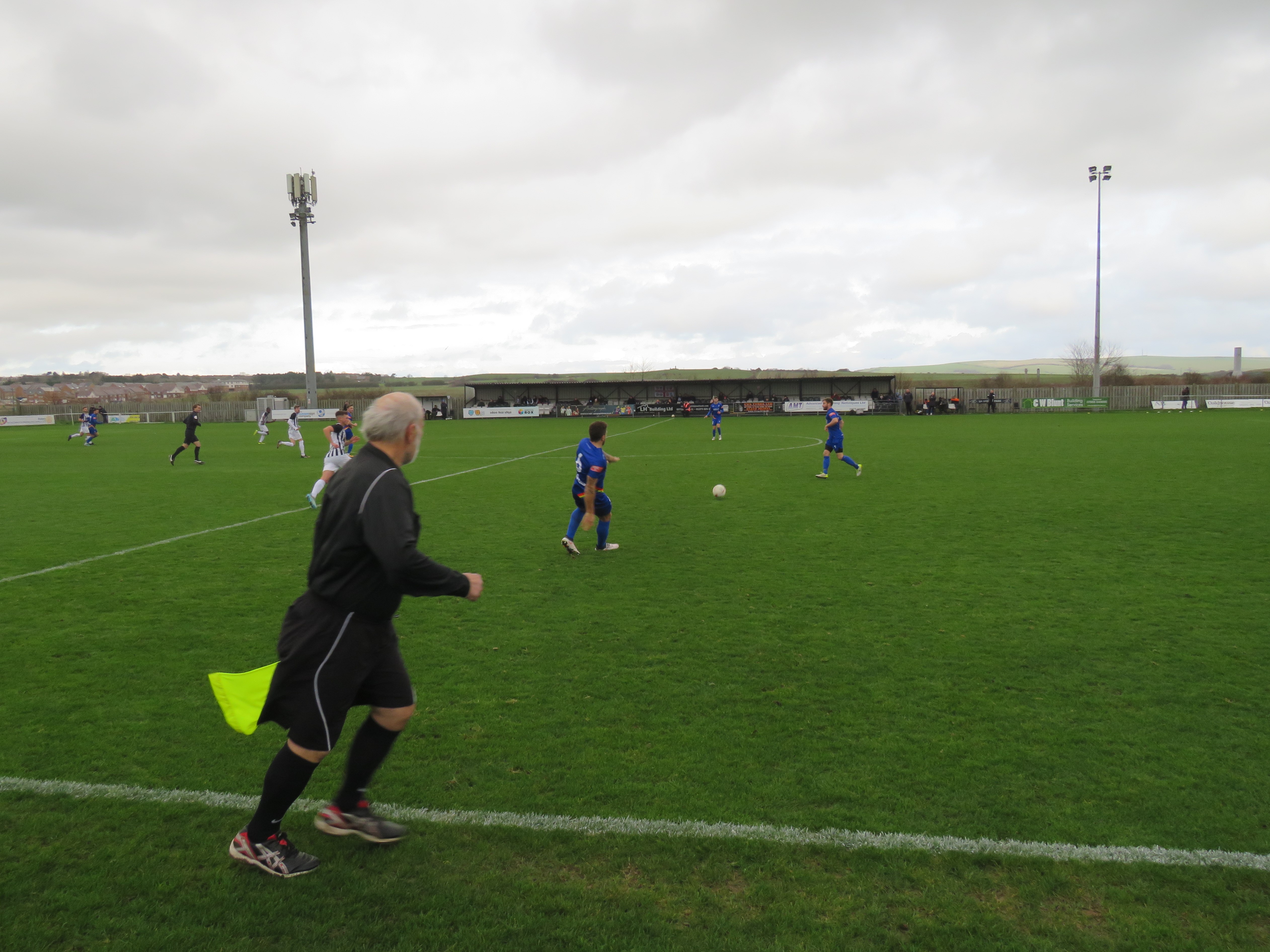
Rodrigues came close to regaining the lead for Whitehawk, whose manager Ross Standen was in charge of only his second game. Debutant Omarr Lawson dragged his shot wide as the visitors, in a snazzy all-blue kit with rainbow trim, smelled blood.

It then started pouring down, with the freezing rain blowing across the pitch from the east, as I quickly realised that a pair of gloves would have been a wise addition to my kit for the day. It really was cold up on top of the cliffs.

The Hawks went 2-1 up with a goal deserving of a grander setting than a friendly match. Henry Muggeridge doggedly won the ball, feeding the jinking Lawson who weaved past defenders before setting up Sobowale to score with a beautiful curling shot into the top corner.

Rodrigues created the third goal with a long, powerful run before he passed to Luke Emberson, who controlled and powered his shot past Cracknell. At the interval, I did my best to warm up with another walk and then hid behind a floodlight pole out of the wind.

Both sides agreed to rolling subs to get everyone into the action. This seemed a wise arrangement as teams were lacking match practice after lockdown disruptions. Sobowale was denied by Cracknell soon after the restart, before the forward hit the rebound wide.

Leon Redwood then fed Rodrigues, whose effort came back off the post, as it looked like a case of how many the Hawks would rack up. Unfortunately, I would have to find out if they did via Twitter, as I had to leave with just over twenty minutes left on the clock.

As it transpired, I missed further goals from Muggeridge fifteen minutes from the end, and then Rodrigues finally added his second and Hawks' fifth.

It had been very cold, but a welcome bonus to catch some action at The Sports Park, where I left with a positive impression of a welcoming community club. I headed back a few miles east for the main event of the afternoon.


AFC Varndeanians


AFC Varndeanians FC is a non-league football club based in Brighton, formed as Old Varndeanians in 1929 after changing titles from Secondary Old Boys, who competed in the Brighton, Hove & District Football League.


Old Vardeanians were relegated in 1930-31 and again in 1934-35 to find themselves in Division Three. The club moved to play matches at Preston Park following World War Two, winning promotion in 1947-48.

The second tier of the competition was renamed the Intermediate Division, from where the team progressed to the Senior Division in 1951-52; before taking up a position in Division Two of the Sussex County League for the 1956-57 season.


After three runners-up finishes before the end of the decade, Vardeanians were promoted to Division One in 1959-60. Club rules were adjusted to allow brothers and sons of former pupils to play for the team along with former pupils of Varndean School.

The side were relegated to Division Two in 1961-62, where the club remained until leaving the league in 1973 to re-join the Brighton, Hove & District Football League, being placed in the Premier Division. Vardeanianas won the league title on their first season back.


A second title followed in 1999-00, following five runners-up slots. The club retained the championship before winning the league once again in 2002-0,3 from where Old Vardeanians moved to the Mid-Sussex League.

The league title arrived in 2003-04, with further league triumphs arriving in 2006-07 and 2008-09. In 2015, the club changed its name to AFC Varndeanians, while moving to play home games at Withdean Stadium as members of Division Two of the Southern Combination Division.


The move paid dividends as Vardeanians won the league at the first attempt to be promoted to Division One. After a couple of seasons of consolidation, the team just missed out on promotion with a third place in 2018-19 under manager Kevin Keehan, who had earlier replaced Keiran Ridley

Lawrence Edwards and Justin Jones had earlier held the managerial post. The club was promoted into the Premier Division on previous performances and then went on to maintain their status for the following three seasons. Edwards returned as boss before departing in May 2025 to be replaced by Bradley Bant.

AFC Varndeanians will play in the Southern Combination League Premier Division in the 2026-27 season.

My visits

Brighton & Hove Albion 2 Gillingham 0 (League One) Tuesday 13th October 2009 (att: 5,960)

Please click here to read about my visit in the days when Albion were the tenants at Withdean.

Monday 22nd July 2019


With the week off work, I wanted to get away from the capital. An arranged evening meeting with old friends in Haywards Heath allowed me to head to the coast for some fresh air and exercise to build up my appetite.

Withdean Stadium wasn’t really on my radar when I set out. My destination was Brighton. However, it seemed a good idea as I approached the seaside, so I alighted at Hassocks and waited for the next train to Preston Park.


It’s strange how the memory can play tricks. I decided to cross below the track as I thought a path would take me straight to the arena. It led to quite a walk up and down steep hills before Withdean Road took me to the entrance.

Fortunately, the gates were open to allow me to take photos. It all looked so different to when the temporary stands and facilities were in situ. It was a pleasant venue, if unsuitable to the crowds it had to accommodate.


The main stand was still in place. Opposite the grass banks with a path mid-way up were now clearly visible. Flat open areas were behind the curves where the structures were before.

Once I’d taken my photos, I walked along London Road, visiting Preston Park cricket ground and velodrome, before continuing past the main park and several inviting pubs and brewery taps in pursuit of trying to shed a little timber.


Brighton was busy with tourists and as good as ever. The sun was out, with the benches on the pier being most welcome in the sunshine. A good day was rounded off with a Thai meal and a few beers with cricketing chums.


East Cowes Victoria Athletic


East Cowes Victoria Athletic AFC is a non-league football club based in East Cowes on the Isle of Wight that was formed in 1885. The ground on Beatrice Avenue was in the grounds of Osborne House, one of Queen Victoria’s homes, hence the club title.


‘The Vics’ became founder members of the Isle of Wight League in 1898, becoming inaugural champions and retaining top spot in 1899-00 before adding further titles in 1930-31, 1934-35 and 1935-36.

In 1947, the club moved to the Hampshire League as members of Division Two, where three runners-up positions were followed up by promotion and the title in 1952-53 before relegation in 1954-55. A further demotion to Division Three came in 1960-61.


The Division Three title was won in 1963-64 to go back up a level, before dropping back down after the 1966-67 campaign. The league was expanded in 1968, with Vics being placed in Division Three West.

Hampshire League re-organisation in 1971 saw East Cowes being put in Division Three, where they became champions to win promotion to Division Two. A third-place finish in 1977-78 saw Vics go up to Division One.


A demotion in 1981-82 was countered by the team regaining its top-flight place twelve months later. East Cowes were crowned as Hampshire League champions in 1985-86 before retaining the title in 1986-87, leading to promotion to the Wessex League.

A bottom-place finish in 1999-00 saw the club relegated back to the Premier Division of the Hampshire League. The team were runners-up in 2001-02 before the competition merged with the Wessex League in 2004.


East Cowes were placed in Division Two, which was retitled Division One for the 2006-07 campaign. Vics finished in fourth position in 2011-12, but aside from that, they generally ended in the lower half of the table.

Tenth place was achieved in 2018-19 under manager Steve Brougham. Newport FC moved in as tenants in the summer of 2019 as they awaited the construction of their new home ground. Vics, like other clubs lower down the non-league chain, saw two seasons abandoned owing to the worldwide pandemic.


In November 2021, Richie Woodburn was appointed as team boss at Beatrice Avenue, remaining in charge until he was succeeded by Alex Smith in December 2022. He led the side to sixth place in the league season of 2023-24 before they reached the playoffs the following season.

Victories over Arlesford Town and then away to Frimley Green after penalties saw the Vics promoted to the Premier Division.

East Cowes Victoria Athletic AFC will play in the Wessex League Premier Division in the 2026-27 season.

My visit

Thursday 5th September 2019

London and the modern world had got to me, and I needed somewhere to escape. I had three days off work and wanted to visit somewhere I’d never been to before. Somewhere relaxed near the coast was my preference. Then I thought of the Isle of Wight.


With a B&B booked for the evening, I set out from Waterloo, arriving slightly later than planned by Hovercraft to Ryde. I was already in a good mood after the journey and seeing somewhere that reminded me of the resorts I’d visited with my parents in the 70s.

A £10 all-day bus pass was bought from the driver of the number 4 service. The journey took us past the stunning village of Wootton Bridge, where it was tempting to abandon ship and spend the afternoon looking at the water from the attractive pub.


The Ashes Test from Old Trafford was keeping me entertained on the radio, even if England were floundering badly. I alighted from the bus at Barton Lodge and walked for less than ten minutes to the entrance of the ground.

A five-bar gate was across the entrance to the venue. I clambered over and then opened the iron gate to get inside the ground so that I could take my usual collection of photos on what was a most pleasant afternoon.


It wasn’t a bad venue. All the facilities were down the Beatrice Avenue side in the form of a low cover for standing spectators and then a neat seated stand on the halfway line, which had the changing rooms and clubhouse behind.

The rest of the ground was open with hard standing all the way around the pitch. Trees behind both goals gave it an enclosed feel, while a practice pitch stood down the far touchline.


Once complete, I took the fifteen-minute walk down into the port, taking the East Cowes-Cowes Chain Ferry across the River Medina in search of the bus towards Cowes Sports FC, Newport and then Shanklin, which was my destination for the evening.