
Swansea City AFC
Ground: Swansea.com Stadium
Capacity: 21,000
Club Founded: 1912
League: EFL Championship (current level)
Swansea City AFC has had as turbulent a history over the past fifty years as any club, reaching the heights and coming close to closure, before finding stability and triumph through moving into a new stadium.
.png)
Swansea City AFC History
Early Years
The football club from the coastal city in the traditional rugby union heartland was not formed until 1912, as Swansea Town AFC. They won the Welsh Cup in their first year, acquired the Vetch Field, a piece of land near the town centre owned by the Swansea Gaslight Company, as their home ground, and joined the Southern League.
The Swans, as the club is nicknamed, along with the Jacks, became founder members of the Football League Third Division in 1920. Within five years, the team was promoted to the League's second tier, going on to reach the semi-final of the 1925-26 FA Cup, where they lost out 3-0 to Bolton Wanderers at White Hart Lane under manager Joe Bradshaw.
The Swans, as the club is nicknamed, along with the Jacks, became founder members of the Football League Third Division in 1920. Within five years, the team was promoted to the League's second tier, going on to reach the semi-final of the 1925-26 FA Cup, where they lost out 3-0 to Bolton Wanderers at White Hart Lane under manager Joe Bradshaw.
.svg)
The Calm Before the Storm
Further Welsh Cup triumphs were added as The Vetch paraded some of the club's most famous names, including Ivor Allchurch, Terry Medwin and Harry Griffiths. In 1963-64, the Swans reached a second FA Cup semi-final when a fine run was ended with a 2-1 defeat to Preston North End at Villa Park, following a quarter-final win at Anfield against Liverpool.
By the end of the 60s, the club was in the bottom tier of the Football League when it changed its name to Swansea City AFC. Roy Bentley managed the team to promotion in 1969-70, but the Swans dropped back down under Busby Babe Harry Gregg as crowds dwindled. Just 1,358 watched the match between Swansea City and Northampton Town.
 |
| The Vetch Field in the Early 70s Image from The Football League Review |
The John Toshack Era
Former Cardiff City, Liverpool and Wales hero John Toshack arrived as player-manager in February 1978 to kickstart an amazing era. Successive promotions were won, taking the Swans to the second tier after fourteen years' absence. Quality players began to join the club to link up with the youth system.
After a season of consolidation, a 3-1 win at Preston North End sent The Swans to the top flight for the first time in their history. Stars of the time included Ian Callaghan, Tommy Craig, Leighton James, Robbie James and Alan Curtis. Two Welsh Cups were also added to the honours board as fans flocked to the Vetch.
After a season of consolidation, a 3-1 win at Preston North End sent The Swans to the top flight for the first time in their history. Stars of the time included Ian Callaghan, Tommy Craig, Leighton James, Robbie James and Alan Curtis. Two Welsh Cups were also added to the honours board as fans flocked to the Vetch.
 |
| The Vetch Field Image Scanned from the Book: The Football Grounds of England & Wales |
Joy Gives Way to Gloom
City hit the ground running, and in their first match in Division One, they demolished Leeds United 5-1 at The Vetch, with debutant Bob Latchford netting a hat-trick. The side finished the season in sixth place, despite topping the table on several occasions. However, the success came at a massive cost. Too much money was spent on players and some transfers.
This led to relegation in 1982-83, with slight consolation being an eighth Welsh Cup triumph. A second successive relegation followed before Toshack departed. The club was under severe threat owing to the crippling debts it racked up. They were saved by local businessman Doug Sharpe in December 1985.
 |
| My drawing of the Vetch Field, with the club crests and former City kits. Click on the image to enlarge it. |
Wembley Debut
Swansea found themselves back in Division Four at the end of the 1985-86 campaign as City had gone right from the bottom of the League to the top, and then back again. Terry Yorath was appointed as manager in May 1986, taking the side to promotion with a playoff final win against Torquay United a couple of seasons later.
More national cup wins arrived under new manager Frank Burrows, whose side lost in the 1992-93 playoffs. In 1994, City made their Wembley Stadium debut when they lifted the Football League Trophy against Huddersfield Town. New owners bought the club and employed Kevin Cullis as boss in February 1996.

Ups and Downs
His only previous experience had been as a youth team coach of the small non-league club, Cradley Town. Sharpe triggered a clause in the sale when he didn't receive his promised cash and returned to the helm. Cullis was sacked after just six days. Former Danish international and Liverpool star Jan Mølby took over, taking the Swans to the playoff final.
Managers continued to come and go regularly, before the experienced John Hollins came in to settle the ship in the summer of 1998. Premier League West Ham United were dumped out of the FA Cup, before City were promoted as champions, a year after missing out in the playoffs. They lasted in the higher division for just one season.

The Corner is Turned
A new owner, Mike Lewis and his company, The Petty Group, based in Australia, took over the club and immediately made cutbacks, angering fans who set up a Supporters Trust. In 2001, a consortium led by former star player Mel Nurse tried to buy the club, with the sale going through a year later.
The club only stayed in the League on the final day of the season under new manager Bryan Flynn following a win against Hull City. Lewis was Vice Chairman of the visiting Tigers and was about to be jailed along with his sidekick, John Russell, for fraud. Kenny Jackett was appointed manager and led the side to promotion in 2004-05.
 |
| Statue of club legend Ivor Allchurch, outside the Liberty Stadium |
A New Stadium Brings New Hope
The celebrations at the increasingly dilapidated Vetch Field were its last action. A new ground had been in the pipeline for many seasons, and at last the club moved to the sparkling Liberty Stadium at White Rock, named after Liberty Properties Ltd, which won the naming rights. The stadium was to be shared with the franchised regional rugby club, Ospreys.
The Swans won a second Football League Trophy against Carlisle United at the Millennium Stadium, but lost to Barnsley in the playoff final back at the Welsh national stadium. Former playing hero Roberto Martinez moved into the managerial hot seat in February 2007. The team played delightful passing football along the floor.

The Premier League Era
Swansea won promotion as League One champions in 2007-08. The highly rated Brendan Rodgers was appointed manager in July 2010. The side won a wonderful playoff final 4-2 at Wembley against Reading. Swansea City became the first Welsh club to reach the Premier League, just eight years after staying in the Football League by beating Hull City.
Rodgers departed to be replaced by Michael Laudrup, for whom Michu scored goals aplenty. The Swans defeated Bradford City to lift the League Cup in 2012-13. Wilfried Bony took over as top scorer, before Laudrup was dismissed in February 2014 to be replaced by former player favourite Garry Monk.

Recent Years
An American consortium became the new owners of the club in the summer of 2016, while chairman Huw Jenkins remained in his position. Those in charge changed managers regularly while veteran captain Leon Britton was put back into the centre of midfield, where he controlled the game, ably assisted by Gylfi Sigurðsson and striker Fernando Llorente.
The Jacks were relegated in 2017-18 before Graham Potter became the new manager, stabilising the squad with Oli McBurnie top-scoring. Steve Cooper took the team to the playoffs in 2019-20, where they fell short again the following season.

Russell Martin, Michael Duff, Luke Williams and Alan Sheehan were the next men to lead the team. Vítor Matos was appointed manager in November 2025.
My visits
At Vetch Field
Swansea City 3 Scarborough 0
Swansea City 3 Scarborough 0
Division Four - Saturday 16th January 1988
👨👨👧👧 4,366 🎟️ Complimentary

It was Scarborough's first-ever season in the League, and they were doing reasonably well. I was lucky at the time that a mate, Doomie, went to every game in his car. I was working as a Postman at the time and had to do a delivery that morning before setting out on the mammoth journey.
Doomie was a driver of Grand Prix proportions. He picked me up at The Angel pub in Scarborough at 10am, with Mick and my brother Nick on board. I expected us to just about make it for kick-off. How little I knew!
To cut the story and nearly as short as the journey, we passed the Boro team coach near the Welsh border and were waiting for them for half an hour at around 1.45pm in the cramped streets behind the ground and by the old jail when they arrived.

It was Scarborough's first-ever season in the League, and they were doing reasonably well. I was lucky at the time that a mate, Doomie, went to every game in his car. I was working as a Postman at the time and had to do a delivery that morning before setting out on the mammoth journey.
Doomie was a driver of Grand Prix proportions. He picked me up at The Angel pub in Scarborough at 10am, with Mick and my brother Nick on board. I expected us to just about make it for kick-off. How little I knew!
 |
| Image - Dave Hunter |
To cut the story and nearly as short as the journey, we passed the Boro team coach near the Welsh border and were waiting for them for half an hour at around 1.45pm in the cramped streets behind the ground and by the old jail when they arrived.
I was friendly with Boro winger Steve Adams at the time, and he would leave me a ticket at the gate when there were any available. I saw Addo as he went through, and he told me to hang on. Ten minutes later, manager Neil Warnock came out and gave us sixteen tickets.

He told us to distribute them amongst the travelling support as none of the players had any relatives going to the match. We went to the pub for a couple of drinks. I found the locals very friendly, and they were keen to tell us how much better the supporters they were than Cardiff City's.

He told us to distribute them amongst the travelling support as none of the players had any relatives going to the match. We went to the pub for a couple of drinks. I found the locals very friendly, and they were keen to tell us how much better the supporters they were than Cardiff City's.
An older gent told me that when Swans fans returned by train after clinching promotion at Preston, Cardiff fans hurled missiles at the carriages, smashing windows as the train went through the city. I'd heard about the intense and bitter rivalry, but I didn't realise it was that bad.

We returned to the Vetch, handed out the tickets, and took up our seats in the Main Stand. The ground really was a strange, cramped ground, but I liked it. The Main Stand was quite low and wooden, with a terraced block at the far end. To our left, the West Terrace was a double-decker stand, with a steep seating deck over a terrace for visiting fans.
Eventually, the seating was closed and then built over towards the stadium's final days. Opposite was the North Bank, a large covered terracing where most of the noise came from. The final end held the unusually shaped East Stand.
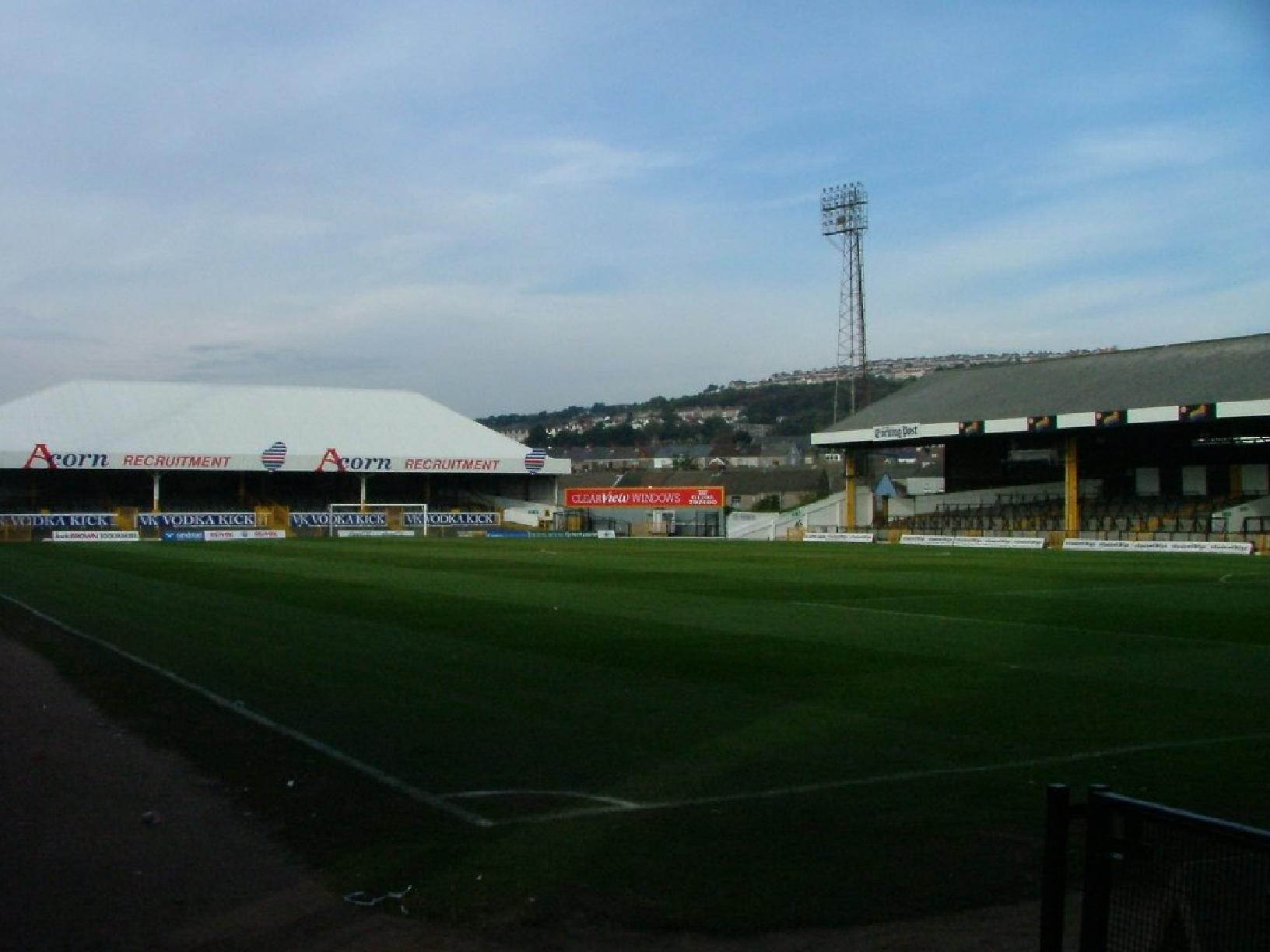
We were optimistic of Boro getting a result, but we were well and truly put in our place as The Swans got revenge for their 2-0 defeat in North Yorkshire earlier in the season. Boro had new signings Kenny Lowe and former Irish keeper Seamus McDonagh in their lineup.

We returned to the Vetch, handed out the tickets, and took up our seats in the Main Stand. The ground really was a strange, cramped ground, but I liked it. The Main Stand was quite low and wooden, with a terraced block at the far end. To our left, the West Terrace was a double-decker stand, with a steep seating deck over a terrace for visiting fans.
Eventually, the seating was closed and then built over towards the stadium's final days. Opposite was the North Bank, a large covered terracing where most of the noise came from. The final end held the unusually shaped East Stand.
We were optimistic of Boro getting a result, but we were well and truly put in our place as The Swans got revenge for their 2-0 defeat in North Yorkshire earlier in the season. Boro had new signings Kenny Lowe and former Irish keeper Seamus McDonagh in their lineup.
They were totally outclassed on the day, with veteran Robbie James scoring a long-range effort past the flailing McDonagh, who was well past his best. City eventually finished sixth in the table, and were promoted courtesy of an aggregate win over Torquay United in the playoff final.
At Liberty Stadium
Swansea City 2 Arsenal 2
FA Cup Round Three - Sunday 6th January 2013
👨👨👧👧 18,848 🎟️ £30

The third round of the world's greatest cup competition is always one of my favourite weekends of the football season. When I saw that the game at Liberty Stadium was scheduled for live TV on my day off, I began to make plans to try to attend.

The third round of the world's greatest cup competition is always one of my favourite weekends of the football season. When I saw that the game at Liberty Stadium was scheduled for live TV on my day off, I began to make plans to try to attend.
On my way to Bournemouth the previous week, I'd eventually got through to the ticket office and managed to secure a ticket for £30, which I was told was on the halfway line. I couldn't wait! As ever, I booked my train in advance, although not as early as I'd wished.

The only service that would get me there in time left Paddington at 8am and was likely to be busy with travelling fans. As I expected, there were large groups of 'Gooners' mingling and waiting to board on the actual day. I moved from the supposed 'quiet' carriage after groups of obnoxious youngsters took it over.

The only service that would get me there in time left Paddington at 8am and was likely to be busy with travelling fans. As I expected, there were large groups of 'Gooners' mingling and waiting to board on the actual day. I moved from the supposed 'quiet' carriage after groups of obnoxious youngsters took it over.
I feared the worst for the four-hour ride, but in fairness, the fans were excellently behaved. The journey was long, stopping many times along the way. Travelling through Cardiff, I saw the Millennium Stadium and Cardiff City Stadium before we took in the highly industrial scenery of Port Talbot. It was grim.

From Neath, the train wound down towards the coast, going past The Liberty and into the station. I had read in advance that the ground was up to two miles from the terminus, but with no buses being due for twenty minutes, I followed the crowds and walked it. Now I know that I can get a march on, but I really didn't expect it to only take me twenty-five minutes.
The queue to collect my ticket was dealt with expertly, so I had an hour to kill before kick-off. The nearby Harvester pub and the Frankie and Benny's selling alcohol were so packed that I didn't fancy the effort, so instead I walked round to my gate and went inside. I had a beer for £3 and then took the meal deal of a good pie and a beer for £5.40.

The concourses were showing the ESPN build-up to the game on the TVs, while I flicked through the excellent £3 programme. I had put a bet on the game ending 2-2 before I went in, but when I saw that Swansea were starting without Michu and Pablo Hernandez while Arsenal were fielding their full-strength line-up, I put a cover bet on a 3-0 away win.
When the lady told me that my seat would be on the halfway line, I was happy, but I remembered buying tickets elsewhere with similar endorsements, only to find myself in a corner. Therefore, when I went upstairs and saw where I was to sit, I was delighted. I was just a few seats off the centre.

I really liked The Liberty Stadium. It was well designed, and every seat had good legroom, no doubt to cater to the well-built rugby fans who visited to cheer on the Ospreys. The stadium was a continuous bowl, with the seating on two tiers separated by a walkway. The West Stand had corporate facilities at the back, while scoreboards hung from the roofs at either end.
Arsenal fans filled the North Stand. They were in good voice, as were The Swans' faithful, as the game kicked off. The first half lacked much goalmouth drama, but it was lovely to watch so many technically gifted players. Swansea were so good to watch. Their players seemed to have so much time on the ball. Leon Britton, Chico, and Ben Davies impressed me the most.

After the interval, both sides moved up a gear, and the pace increased, although chances were still at a premium. Swansea boss Michael Laudrup introduced the missing two before an hour was out, and this move had an immediate effect when Michu used great skill to get away and finish past Wojciech Szczęsny.
They looked in control until Laudrup gave Britton a rest, no doubt with that week's League Cup semi-final against Chelsea in mind, after sixty-eight minutes, and this changed the game. Arsenal gained more and more possession and forced mistakes from the home team. Lukas Podolski was introduced as a substitute with nine minutes remaining.

From Neath, the train wound down towards the coast, going past The Liberty and into the station. I had read in advance that the ground was up to two miles from the terminus, but with no buses being due for twenty minutes, I followed the crowds and walked it. Now I know that I can get a march on, but I really didn't expect it to only take me twenty-five minutes.
The queue to collect my ticket was dealt with expertly, so I had an hour to kill before kick-off. The nearby Harvester pub and the Frankie and Benny's selling alcohol were so packed that I didn't fancy the effort, so instead I walked round to my gate and went inside. I had a beer for £3 and then took the meal deal of a good pie and a beer for £5.40.

The concourses were showing the ESPN build-up to the game on the TVs, while I flicked through the excellent £3 programme. I had put a bet on the game ending 2-2 before I went in, but when I saw that Swansea were starting without Michu and Pablo Hernandez while Arsenal were fielding their full-strength line-up, I put a cover bet on a 3-0 away win.
When the lady told me that my seat would be on the halfway line, I was happy, but I remembered buying tickets elsewhere with similar endorsements, only to find myself in a corner. Therefore, when I went upstairs and saw where I was to sit, I was delighted. I was just a few seats off the centre.

I really liked The Liberty Stadium. It was well designed, and every seat had good legroom, no doubt to cater to the well-built rugby fans who visited to cheer on the Ospreys. The stadium was a continuous bowl, with the seating on two tiers separated by a walkway. The West Stand had corporate facilities at the back, while scoreboards hung from the roofs at either end.
Arsenal fans filled the North Stand. They were in good voice, as were The Swans' faithful, as the game kicked off. The first half lacked much goalmouth drama, but it was lovely to watch so many technically gifted players. Swansea were so good to watch. Their players seemed to have so much time on the ball. Leon Britton, Chico, and Ben Davies impressed me the most.

After the interval, both sides moved up a gear, and the pace increased, although chances were still at a premium. Swansea boss Michael Laudrup introduced the missing two before an hour was out, and this move had an immediate effect when Michu used great skill to get away and finish past Wojciech Szczęsny.
They looked in control until Laudrup gave Britton a rest, no doubt with that week's League Cup semi-final against Chelsea in mind, after sixty-eight minutes, and this changed the game. Arsenal gained more and more possession and forced mistakes from the home team. Lukas Podolski was introduced as a substitute with nine minutes remaining.
He quickly made an impact, equalising two minutes later with a classy finish. Arsene Wenger's side had the momentum, and it was no surprise when Keiren Gibbs smashed home a volley, completing a clever one-two to send The Gooners behind the goal wild with delight. I couldn't see a way back for Swansea.

However, I failed to take into account Arsenal's defence, which drove their fans mad in frustration on several occasions throughout the season. Korean international Sung-Yong Ki had a good chance to level the scores, which he fluffed, but from the ensuing corner he teed up Danny Graham, who belted the ball into the roof of the net.
No one was more delirious than me. My bet was on, as I mentioned it to those around me. It's not over yet, replied a local, and indeed the home team had another half-chance. I forgot myself and groaned when it came to nothing, along with everyone else. After five minutes of stoppage time, Howard Webb brought an end to proceedings as both teams received a well-deserved ovation.

I left and rang my Dad. Sometimes, when at a game, it can seem better than it actually was as you get carried away in the atmosphere, but he confirmed that it was a cracker. I also concurred that my bet's odds of only 10/1 were extremely skinny. I arrived back in the city centre within twenty minutes, with my train not leaving until 6.50, giving me the best part of three hours to kill.
Now I love pubs and even more so in towns I've never been in before. Often, time beats me, but Swansea definitely proved to be the exception. I was advised that Wind Street was the place to be, and indeed, there were lots of bars, but it seemed more suited to weekend evenings.
In the end, I opted for the Wetherspoons Bank Statement. It was OK, but nothing startling, and I wanted to see some of the Mansfield v Liverpool match. After two pints, I went in search of a pub with hand pumps. I was to fail.

It was rather ironic that I'd been involved in a conversation on Facebook regarding how the price of drinks in Australia had gone through the roof since some of us had visited. I entered the Aussie-themed Walkabout, knowing I could get a small bottle of Tooheys New in there, which was at least palatable.
I nearly fell over as I was charged £3.70, and then young Sophie poured it into a plastic pint glass. She apologised but said it was pub policy. I was not hugely happy, and it was only her charm that saved her from a rant. To make matters worse, the bar appeared to be filled with screaming young drunks.

I moved on to The Varsity, having used other establishments part of that chain in the past. Alas, there was no proper ale, but at least it was a decent place. I noticed that all the pubs had doormen on, despite hardly anyone being out! I still had time for one more on the way back, so I chanced on The Adam and Eve.

However, I failed to take into account Arsenal's defence, which drove their fans mad in frustration on several occasions throughout the season. Korean international Sung-Yong Ki had a good chance to level the scores, which he fluffed, but from the ensuing corner he teed up Danny Graham, who belted the ball into the roof of the net.
No one was more delirious than me. My bet was on, as I mentioned it to those around me. It's not over yet, replied a local, and indeed the home team had another half-chance. I forgot myself and groaned when it came to nothing, along with everyone else. After five minutes of stoppage time, Howard Webb brought an end to proceedings as both teams received a well-deserved ovation.

I left and rang my Dad. Sometimes, when at a game, it can seem better than it actually was as you get carried away in the atmosphere, but he confirmed that it was a cracker. I also concurred that my bet's odds of only 10/1 were extremely skinny. I arrived back in the city centre within twenty minutes, with my train not leaving until 6.50, giving me the best part of three hours to kill.
Now I love pubs and even more so in towns I've never been in before. Often, time beats me, but Swansea definitely proved to be the exception. I was advised that Wind Street was the place to be, and indeed, there were lots of bars, but it seemed more suited to weekend evenings.
In the end, I opted for the Wetherspoons Bank Statement. It was OK, but nothing startling, and I wanted to see some of the Mansfield v Liverpool match. After two pints, I went in search of a pub with hand pumps. I was to fail.

It was rather ironic that I'd been involved in a conversation on Facebook regarding how the price of drinks in Australia had gone through the roof since some of us had visited. I entered the Aussie-themed Walkabout, knowing I could get a small bottle of Tooheys New in there, which was at least palatable.
I nearly fell over as I was charged £3.70, and then young Sophie poured it into a plastic pint glass. She apologised but said it was pub policy. I was not hugely happy, and it was only her charm that saved her from a rant. To make matters worse, the bar appeared to be filled with screaming young drunks.

I moved on to The Varsity, having used other establishments part of that chain in the past. Alas, there was no proper ale, but at least it was a decent place. I noticed that all the pubs had doormen on, despite hardly anyone being out! I still had time for one more on the way back, so I chanced on The Adam and Eve.
This pub was superb if you enjoyed screaming kids, 1980's music, and ale that tasted like it had been in the pump for a week. It was that bad that I left half of it. There was still time to buy some food from one of the many tatty takeaways near the station. I purchased a supposed meat feast 9' pizza, fries, and a can of Coke for £5.70!

It was only when I got on board the train and began it that I realised I'd been overcharged by about £2 for the quality. It did a job, and I slept like a baby until we approached Reading. It had been a long day out, but I really enjoyed the game and the stadium.
If I were visiting the town again, perhaps for cricket, I'd definitely head to The Mumbles. It has a great reputation, but it wouldn't need to be much to beat Swansea's pubs!
A City Return
Sunday 28th May 2017

My return to Swansea was not for football, but for the County Championship cricket match between Glamorgan and Durham.
I'd arrived the day before and noted that my bus ride in shocking weather from the railway station to the St Helen's Ground went past William Street. I was pretty sure that was where the Vetch Field was located.

My only visit to the ground when it was still standing had been a long time ago, and I was unsure of its exact location, but Google Maps put me right. Sure enough, other familiar street names surrounded what looked like open space.
On Sunday morning, the weather was looking promising for cricket as I set off on a pre-match walk in search of breakfast and a little bit of football history. I was staying at the Tudor Court Hotel, along the waterfront on Oystermouth Road.

I'd noted the night before that the old Swansea Jack pub was now boarded up. My Durham pals had told me another nearby pub, The Builders Arms, was not exactly salubrious. The Vetch closing had seen once thriving establishments suffer badly.

Allotments had taken over down the side where the Main Stand once stood. A concrete-circled path signified the location of the old centre circle. Much of the old hill from the North Bank had gone, although there was still a slope. A kids' playground meant there was still some recreation taking place.

As I wandered further down Glamorgan Street, it was good to see the signs for the East Stand had been left for future generations to learn where their club history was forged and for older fans to remember.
Further evidence was found on Madoc Place and Madoc Street, where the exit gates were still in place, while it was clear where the turnstiles once let in fans by the thousands for City and Wales games, as the entrances had been bricked up.

It had been a good start to the day. I love retracing my footsteps many years later, especially if I'd been a little unprepared on previous visits. The cricket, company, and some decent pubs added to a cracking day and weekend away.

I even picked up a free independent magazine, 'The Jack', in a local pub at night. It showcased local businesses and pubs, and contained articles about the club from a fan's perspective. I thought it was a fabulous innovation.
Sunday 28th May 2017

My return to Swansea was not for football, but for the County Championship cricket match between Glamorgan and Durham.
I'd arrived the day before and noted that my bus ride in shocking weather from the railway station to the St Helen's Ground went past William Street. I was pretty sure that was where the Vetch Field was located.

My only visit to the ground when it was still standing had been a long time ago, and I was unsure of its exact location, but Google Maps put me right. Sure enough, other familiar street names surrounded what looked like open space.
On Sunday morning, the weather was looking promising for cricket as I set off on a pre-match walk in search of breakfast and a little bit of football history. I was staying at the Tudor Court Hotel, along the waterfront on Oystermouth Road.

I'd noted the night before that the old Swansea Jack pub was now boarded up. My Durham pals had told me another nearby pub, The Builders Arms, was not exactly salubrious. The Vetch closing had seen once thriving establishments suffer badly.

Allotments had taken over down the side where the Main Stand once stood. A concrete-circled path signified the location of the old centre circle. Much of the old hill from the North Bank had gone, although there was still a slope. A kids' playground meant there was still some recreation taking place.

As I wandered further down Glamorgan Street, it was good to see the signs for the East Stand had been left for future generations to learn where their club history was forged and for older fans to remember.
Further evidence was found on Madoc Place and Madoc Street, where the exit gates were still in place, while it was clear where the turnstiles once let in fans by the thousands for City and Wales games, as the entrances had been bricked up.

It had been a good start to the day. I love retracing my footsteps many years later, especially if I'd been a little unprepared on previous visits. The cricket, company, and some decent pubs added to a cracking day and weekend away.

I even picked up a free independent magazine, 'The Jack', in a local pub at night. It showcased local businesses and pubs, and contained articles about the club from a fan's perspective. I thought it was a fabulous innovation.


No comments:
Post a Comment