Thursday, 27 July 2017

Bishop Auckland


Bishop Auckland FC is a non-league football club from the County Durham town of the same name, with a rich and proud history since its formation in 1886 as Auckland Town FC.

Auckland Town was a breakaway club from a team called Bishop Auckland Church Institute, which had been formed in 1882 by students from Oxford and Cambridge University who were studying at Auckland Castle, the home of the Bishop of Durham.


The club was a founder member of the Northern League in 1889-90 before the club left to join the Northern Alliance after just one season, before returning in 1893 as Bishop Auckland FC. Success was just around the corner at Kingsway, which was shared with the cricket club.

Auckland lifted the FA Amateur Cup in 1895-96 after defeating Royal Artillery Portsmouth by a solitary goal in the final at Walnut Street in Leicester. The victory was followed up in 1898-99 as the club became Northern League champions.

A scan of the Main Stand at Kingsway

The 1899-00 season saw a second Amateur Cup win. This time, Lowestoft Town were defeated 5-1 at Leicester. The following season saw a second Northern League crown arrive at Kingsway. The title was retained in 1901-02 as the team finished runners-up in the Amateur Cup after going down 5-1 to Old Malvernians at Headingley.

Bishops were also beaten finalists in 1905-06 when Oxford City ran out 3-1 winners at Stockton-on-Tees. The same season also saw the team defeated at Molineux by Wolverhampton Wanderers in the first round of the FA Cup.

The 1908-09 campaign saw the club clinch its fourth Northern League title after defeating South Bank in a play-off. The following season saw the title kept by Bishop Auckland, while a sixth championship was collected in 1911-12.

Kingsway, as scanned from a book

The Amateur Cup was won for the third time in 1913-14 by courtesy of a 1-0 win against Northern Nomads at Leeds. The team progressed to the following year’s final but lost out 1-0 to Clapton at The Den.

The early 1920’s were to see two great consecutive seasons as the Northern League and Amateur Cup double was completed in 1920-21 and 1921-22. Both cup finals were at Middlesbrough’s Ayresome Park, with Swindon Victoria and then South Bank the runners-up.

An eighth Northern League title was lifted in 1930-31 before ‘The Two Blues’ won the Amateur Cup in 1934-35 with a 2-1 win against Wimbledon at Stamford Bridge after the first game had ended goalless at Ayresome Park.

A scan of the old terrace at Kingsway

A couple of second-place league finishes were bettered in 1938-39 as a ninth Northern League was won. The team completed the double with Amateur Cup victory in a 3-0 win against Willington at Roker Park, Sunderland, with future Liverpool manager Bob Paisley in the team.

After peace was restored following World War II, the club was soon collecting honours once more. The 1945-46 Amateur Cup final saw a 3-2 defeat to Barnet at Stamford Bridge, along with a run to the FA Cup second round, although the Northern League title was secured in 1946-47.

A couple more league runners-up positions were achieved before the tenth Northern League title came in 1949-50. The same season saw Willington defeat Bishop Auckland 4-0 at Wembley in the Amateur Cup Final.


However, the Amateur Cup would see an awful lot of the club in the 1950’s as the club entered a golden period. Successive Northern League titles were won in 1950-51 and 1951-52 to complete a hat trick of successes. The Two Blues reached Wembley in the Amateur Cup final of 1951, where they were defeated by Pegasus.

After finishing as league runners-up in 1952-53 as well as reaching the second round of the FA Cup, where the side were eliminated by Coventry City in front of 17,000 fans at Kingsway, Auckland won the Northern League in 1953-54 as well as reaching Wembley once again.


The Amateur Cup final of 1954 against Crook Town turned into an epic as the first game ended in a draw. A replay at St James’ Park failed to separate the teams. Crook won the third game 1-0 at Ayresome Park.

Striker Seamus O'Connell moved to Chelsea as the 1954-55 season was arguably the greatest in the club's fantastic history. The Amateur Cup was won in front of 100,000 fans at Wembley against Hendon. A fourteenth Northern League title was won, while in the FA Cup, a run saw wins over Kettering Town, Crystal Palace, and Ipswich Town, which saw Bishop’s reach the fourth round.


The team eventually went out to eventual beaten semi-finalists York City at Kingsway. The 1955-56 season tried hard to equal such amazing feats, but the team went out in round two of the FA Cup to Scunthorpe & Lindsey United. However, the Northern League title was retained, and the Amateur Cup remained at Kingsway following a 4-1 win against Corinthian Casuals in a replay at Ayresome Park after the first game at Wembley ended 1-1.

The 1956-57 campaign also saw cup glory. The team went out in the FA Cup at the second round stage to Rhyl, while the Amateur Cup was won for a third consecutive year. Wycombe Wanderers were defeated 3-1 in the Wembley final.


However, this proved to be the last honour for a few years. Following the Manchester United Air Disaster of 1958, Bishop Auckland star players Derek Lewin, Bob Hardisty and Warren Bradley moved to the Old Trafford club. Bradley went on to win England caps at professional and amateur levels in the same season.

In 1960-61, Bishop Auckland were Northern League runners-up, as well as going on to reach the second round of the FA Cup, where they went out to Stockport County. The team reached the same stage in 1966-67, as well as securing a sixteenth Northern League crown.

The 1970’s were a bleak decade in terms of honours. Northern League runners-up in 1972-73 and 1978-79 were as close as the club got to winning the title. However, a fine FA Cup run in 1974-75 cheered the Kingsway faithful.


Wins in the qualifying rounds against Stanley United, Whitley Bay, Spennymoor United and Lancaster City saw Bishop’s paired with Morecambe. The reward for the 5-0 win was a draw against Preston North End at Kingsway, which Bobby Charlton’s side won 2-0. The following decade saw Bishop Auckland collect Northern League titles in 1984-84 and 1985-86. 

A hat trick was denied in 1986-87 as the team ended in second spot. An FA Cup first-round appearance came the following season, but ended in defeat at home to Blackpool. The club looked to advance up the football pyramid and joined the Northern Premier League Division One for the 1988-89 season, winning promotion to the Premier League in their debut campaign.


The 1989-90 season saw the Two Blues once again reach the FA Cup second round stage. After a 1-1 draw at Gresty Road against Crewe Alexandra, the team went out 2-0 in the replay at Kingsway. The first round stage of the FA Cup was also achieved in 1990-91 and 1994-95, but ended in defeat to Barrow and then at Bury on penalties in a replay at Gigg Lane. 

Bishop Auckland sat comfortably in the Premier Division for several seasons before finishing as runners-up in 1996-97. The club had been looking to try to move from Kingsway for several seasons. The town centre ground was ageing, and the club had to share the facility. The club moved out at the end of the 2001-02 season, which also ended in relegation on the pitch.

Kingsway in 2017. Now purely a cricket ground

The club moved to play home games at Dean Street, Shildon, while looking to develop a ground at Tindale Crescent on the southern edge of town. The Two Blues won promotion back to the Premier Division in 2003-04. Bishop Auckland became tenants at Spennymoor’s Brewery Field, where they were relegated back to Division One of the Northern Premier League. 

Returning to Shildon, the club was relegated back to the Northern League in 2006-07. 
Meanwhile, progress of sorts had at least been made off the pitch. The club received a full Football Foundation grant towards the new ground, with planning permission being granted in November 2008 as part of a regeneration project.

Kingsway in 2017. Huge crowds once cheered on the Two Blues
where the modern housing now stands

Bishop’s left Shildon to play home games at the Darlington Road home of near neighbours West Auckland Town while struggling at the wrong end of the Division One table in the Northern League as finances were stretched. Eight years after leaving Kingsway, Bishop Auckland’s new Heritage Park home was opened by Sir John Hall in October 2010 before a match against Middlesbrough. 

Within a couple of years, the team regularly began to finish comfortably in mid-table. 
Darlington FC became tenants at Heritage Park from the start of the 2012-13 season until Christmas 2016, bringing in valuable income to the landlords, who continued to finish just above halfway in the Northern League top tier.

In May 2018, Ian Chandler was appointed the Two Blues manager before the arrival of Andy Toman in October 2020, who was succeeded by Chris Hardy in October 2021. He took the side, earlier helped by the goals of Andy Johnson, to the Northern League title in 2023-24, the nineteenth time that the club had been crowned champions.

This led to promotion to Division One East of the Northern Premier League, with Hardy stepping down in November 2024 to be replaced by Leon Carling as the side consolidated at their higher status, before the appointment of new boss Andy Dixon in October 2025, who departed fourteen months later.

Martin Gray was given the manager's job in January 2026. The team was relegated on the final day of the season to Division One of the Northern League.

Bishop Auckland FC will play in the Northern League Division One in the 2026-27 season.

My visit

Wednesday 26th January 2017

It was the beginning of a football week on the road, and I decided the best way to spend some quality time before Scarborough Athletic’s North Riding Senior Cup tie at Stokesley was to visit some new places and historical football clubs.


I’d moved through the fog in Darlington and Shildon from where the Max 1 bus service had dropped me virtually outside Heritage Park. My first views were stood by a hut next to the Sainsbury’s petrol station. Once I’d had a look and taken some photos, I walked round behind the stand where I found an open gate just beyond.

This enabled me to take a proper look at the venue, which had quite a bit in common with the new home of Scarborough Athletic. There was a covered terrace at the far end, with some open seating at the other end from the days when Darlington were tenants. The Main Stand was all seated and contained all the club facilities. The remainder of the ground was flat grass and hard standing.


Once I’d taken my photos, I headed to the other side of the huge Tesco’s and waited to take the number 6 bus towards West Auckland. However, my connection with Bishop Auckland wasn’t over for the day. From West Auckland, I continued north to Willington before returning to the bus station at Bishop Auckland. 

I needed to catch a later train to Middlesbrough to get a bus connection down to Stokesley. I couldn’t leave the town without popping into Kingsway and seeing if there were any remains. It had always been a regret that I’d never been to a football match at the venue, despite Scarborough playing them in different cups over the years. 


I’d been told of passionate and even hostile home crowds. Sadly, there was very little to show that 17,000 fans once packed in, or that this was the home of one of the great non-league clubs of all time. At least the cricket ground remained and looked nice.


Weymouth


Weymouth FC is a non-league football club formed in 1890, located in the seaside town of the same name on the south coast of England in the county of Dorset.

The 'Terras’, nicknamed as such because of the club's terracotta colours, started out playing matches at Lodmore, before moving to Goldcroft Road, Westham, from where they became founder members of the Dorset League and lifted the Dorset Junior Cup on three occasions.


In 1897, Weymouth negotiated a lease with the town council to move into a new ground in the town centre, originally named the Athletic Ground, later renamed the Recreation Ground, as they became members of the Western League in 1907-08, joining Division Two. Weymouth left the Western League in 1914 but returned for the 1921-22 season. 

The club was placed in Division One, becoming league champions in 1922-23. The club opted to drop down to Division Two in 1928, before going on to lift the divisional title in 1933-34, 1936-37 and 1937-38. Following the Second World War, Weymouth enjoyed a purple patch, winning promotion from Division Two of the Western League in 1947-48 and enjoying some fine exploits in the FA Cup.


The 1948-49 season saw the team defeat Trowbridge Town in the fourth qualifying round to set up a tie at The Recreation Ground against Chelmsford City, which was won 2-1, before bowing out at home to local rivals Yeovil Town in Round Two. Weymouth joined the Southern League at the end of the season.

The Cup run in 1949-50 went one better. A win in the first round against Aldershot was backed up with a home win over Hereford United. Weymouth’s reward was a third-round tie away to Manchester United. United won the match 4-0 at Maine Road, as Old Trafford was still being repaired following the War.

Weymouth finished as Southern League runners-up in 1951-52 and 1954-55. The decade also saw the team reach the second round of the FA Cup on four occasions. Notable victories were accrued against Bedford Town, Salisbury, and Shrewsbury Town until the Terras bowed out to Bristol Rovers, Leyton Orient, Southend United, and Southampton.


The 1961-62 season saw Weymouth defeat Dorchester Town, Barnet, Newport County, and Morecambe to reach Round Four, where the side went down 2-0 to Preston North End at Deepdale.

Weymouth won the Southern League title in 1964-65, before going on to retain the title the following season. In the 1968-69 season, a win over Yeovil Town in the FA Cup saw the club reach round two, where they went out in a replay to Swansea City.

After finishing as Southern League runners-up in 1977-78, as legendary manager Brian Godfrey began his spell at the club, Weymouth became founder members of the Alliance Premier League, as the Conference and then the National League was originally titled, for the 1979-80 season.


Star defender Graham Roberts made his mark before being transferred to Tottenham Hotspur in May 1980 for £35,000. The 1982-83 season saw Weymouth reach the third round of the FA Cup following victories against Cheltenham Town, Maidstone United, and Cardiff City. The run was ended at the Abbey Stadium, away to Cambridge United, as future Premier League star Andy Townsend made his mark at the club.

Weymouth moved from their town centre Recreation Ground to the out-of-town Wessex Stadium in 1987 as Godfrey was replaced by Stuart Morgan. Manchester United were the opponents for the official opening.


The move was initially a success until the team was relegated to the Southern League at the end of the 1988-89 campaign as Morgan made way for new boss Gerry Gow, as the future top-flight player Shaun Teale led the defence before moving to AFC Bournemouth for a £50,000 fee.

Further disappointment followed, as Weymouth were relegated to the Southern Division in 1990-91. The team regained its Premier Division status in 1991-92 with Len Drake in charge of the team, after finishing as league runners-up.

However, the turbulent period didn’t end there as the Terras went down once again in 1992-93 under experienced boss Len Ashurst. Weymouth returned to their top-flight status in 1997-98 under manager Fred Davies after managers such as Trevor Senior, Graham Carr, and Neil Webb all failed in the position at the Wessex Stadium.


Journalist and author Ian Ridley took control of the club in 2003–04, appointing veteran football league goalscorer Steve Claridge as player-manager, in a move that provided the club with much publicity as gates increased and the team just missed out on promotion to the Conference.

Martyn Harrison arrived as a board member in a move that led to Ridley departing. Harrison soon sacked Claridge, with Steve Johnson and then Garry Hill taking over as manager. Harrison tried to sell the Wessex Stadium to Asda, but the plans were turned down, while the club became a member of the newly formed Conference South.

In the 2005-06 season, Weymouth managed to draw 1-1 away to Nottingham Forest in the first round of the FA Cup, before losing the home replay, and going on to lift the Conference South title and join the National Division.


In January 2007, Harrison made the full squad available for transfer to save the club financially, as Hill was replaced by Jason Tindall. Harrison sold the club to Tindall’s father-in-law, who proceeded to sack the manager and replace him with former Chelsea legend John Hollins, as further plans were drawn up to relocate the club to a new site in town.

Malcolm Curtis took over the club ownership as Weymouth hit serious financial troubles. Players departed with the club £30,000 in debt, forcing the under-18s to play in a home game against Kettering Town that ended in a 0-9 home defeat. Ridley returned in March 2008 and put former Wales boss Bobby Gould in charge of the team, but it was too little too late as Weymouth plummeted to relegation to the Conference South.


Matty Hale was appointed as the new manager in May 2009, before the board announced in August of that year that Weymouth FC needed £50,000 to stave off Administration and possible liquidation. Local businesses rallied to raise the required cash.

Ian Hutchison replaced a struggling Hale, before Ridley and chief executive Dave Higson departed. Once again, the club was threatened by possible high court action before it was sold to former Cambridge United chairman, George Rolls.

Jerry Gill was appointed as the new manager before Rolls announced that the club was £822,000 in debt and proposed that they enter a Company Voluntary Agreement. The team was relegated to the Southern League after the 2009-10 season.


Fans' favourite Hutchison was re-employed as manager as the Wessex Stadium was renamed The Bob Lucas Stadium in honour of the eighty-five-year-old club president Bob Lucas, who died from cancer shortly after.

Harrison was sacked for a second time, to be replaced by former Terras player Martyn Rogers, who faced an uphill battle as the team was deducted ten points for entering into a CVA. The team escaped relegation on the final day of the season by bettering the result of Didcot Town.

Director and lifelong fan Nigel Biddelcombe completed a takeover of the club from Rolls, who departed and helped in the financial demise of Kettering Town. Biddelcombe set up a Supporters Trust so that no one person could have total control of the club again.


Brendon King was appointed as manager in June 2011 as the club began to rebuild slowly. He lasted until December 2013 when the former Weymouth goalkeeper Jason Matthews took over, leading the side to a couple of seventh-place finishes. Matthews was dismissed in April 2017 after a disappointing season saw Weymouth eventually finish in tenth position. 

Another former player and England C international, Mark Molesley, was appointed in his place. The Terras ended the 2017-18 campaign in the playoff places, but lost 3-0 away to King's Lynn Town in the semi-final before being transferred to the newly formed Premier Division South for the 2018-19 season.

Molesey's team went on to become champions, sealing the title on the final day of the 2018-19 season and winning promotion to the National League South. Weymouth went one better by winning promotion to the top level of non-league football in 2019-20. Brian Stock came in as manager in September 2020 after Molesey went to Southend United.


Stock remained at the helm until January 2022. David Oldfield was his successor, but the Terras were relegated a few months later to the National League South. Bobby Wilkinson was the next incumbent of the managerial role before Molesey returned in April 2024. His second coming didn't work out, leading to the appointment of Warren Feeney in November 2024. 

His appointment couldn't save the side from relegation back to the Southern League, departing in August 2025 to herald the return of former hero Steve Claridge. He was replaced a few months later by Jamie Wells, whose side was relegated at the end of the season.

Weymouth FC will play in the Southern League Division One South in the 2026-27 season.

My visits

Weymouth 0 Torquay United 1 (Saturday 22nd July 2017) Pre-Season Friendly (att: 528)


It was my long weekend away from work, so armed with cheap advanced rail tickets, I headed to Waterloo, a little seedier than preferred after attending the T20 at The Oval between Surrey and Middlesex the night before. I broke up my journey in Dorchester so that I could go and have a look at Town’s Avenue Stadium.

I arrived around 12.30pm on the seafront in Weymouth, ready for adventure for seven or so hours. Social media assisted, as Col Whelan saw my Facebook post and location. He was able to offer me pub advice, but first I had a walk to have a look at the marina, the bustling town centre, and wander over the scenic area around the River Wey.


Taking Col’s advice, I located the Boot Inn in the old High Street across the bridge. Weymouth’s oldest pub had a decent choice of beer in a lovely building. Talk among the blokes was about the ridiculous transfer fees in modern football. I concurred totally. 
I’d planned to get to the Bob Lucas Stadium bus and then walk. 

However, as I walked outside the pub, the heavens opened. I think my stop was outside Asda, the site of Weymouth FC’s old Recreation Ground. The rain was so heavy that I headed to town looking for shelter and came across a taxi office completely by accident. I needed no second invitation. Within minutes, my car had arrived, and I was outside the stadium for a £7 fare.


I paid my £9 admission fee at the ground and went to the second-floor bar via an entrance on the ground floor of the Main Stand. No programmes were printed, and although I saw a few teamsheets, I never saw anyone selling them. Upstairs, I bought a bottle of Ringwood 49er beer, failing to remember that it was on the strong side. 

The Chelsea v Arsenal friendly from China was on the TV, though not too many were giving it anything other than a cursory glance. Showers were threatening as I walked back outside to purchase a pie and a Bovril before I took up a position in the raised seated Main Stand to take a look at the substantial venue. The portions of chips for £3 were the largest I think I’d seen in a ground.


My initial impression was that the ground needed some attention and maintenance. It had been built with League football being the ambition. The club's financial struggles had obviously had a knock-on effect regarding aesthetics. It was too big for the club, especially given their status at the time. The other three sides had a cover over the banks of terracing that wrapped all the way around the pitch. 

Crush barriers were aplenty, along with fencing for segregation as and when required. All four sides had toilet facilities, with three having open refreshment stalls. A hundred or so visiting Gulls had travelled west for the game, including a minibus full of rabble who’d obviously taken on drink. Home fans had also turned out in decent numbers. Their team started off in fine style.


Centre forward Harry Baker had made the step up from Gillingham Town and was proving a handful for the Torquay defence. He came close with a low shot after Calvin Brooks created the opportunity. He continued to feature throughout the half. Terras’ Callum Buckley had an earlier deflected shot saved by Ryan Clarke. Baker came close again but was off-target trying to lob Clarke. 

New Zealand international Rory Fallon was appearing on trial for Torquay, and he came close with a header. Weymouth had the better of the first period, Torquay’s player-manager, Kevin Nicholson, but the ex-Scarborough FC full-back must have had words during the interval as his side looked a different outfit immediately after the break.


During the interval, I found out that I was one number away from winning £10 in the halftime draw. The range of prizes, both for the cash and meat draws, was plentiful. I’d have struggled with chicken fillets on the train home, mind! After forty-seven minutes, Jon-Paul Pittman got to a flicked header from Fallon, outmuscling defender Toby Down, before slotting home past home keeper Mark Travers. 

United’s dominance would continue for long periods in the second half. With twenty-five minutes remaining, Travers pulled off a fantastic double save. He pushed away an effort from Harry Bell before the ball was returned into the box. Yan Klukowski saw his header superbly stopped.


The visitors made several changes to enable their players some valuable match time. They remained pretty much in control of the game, although Weymouth’s Brandon Goodship came close with an angled drive that went over the bar. I enjoyed the changes as they brought the PA man into action. He sounded like a jolly chap doing a passable impression of Benny Hill singing “Ernie, the Fastest Milkman in the West.” 

He could not pronounce his Rs. It made me chuckle. Perhaps it was the beer? It had been a decent match to watch for a neutral as both sides gave plenty of effort. Weymouth had impressed me. At full time, I put in my own exercise period as I walked up the hill on Radipole Lane to the Fiveways bus stop, where I caught the service back to the terminus.


With time to kill, I wanted to find a nice pub for an hour or so before eating. The Dolphin in Park Street looked to be just the job. It belonged to the Hop Back Brewery of Salisbury. I liked their beers, and when I saw that Summer Lightning was on offer, I was more than happy. It was a friendly pub, whose customers I described at the time on social media as being like contestants from the TV show Bullseye. 

There was decent enough background music while the British Open was on TV. The nice, clean pub had a separate area for families and those wishing to play darts or board games. The amiable landlord helped with suggestions for supper and allowed me to charge my phone.


I got talking to a local about the golf. He was keener than I on the game, but it was lovely to have a chat and enjoy some of the amazing play and scenic camera work. It was an hour well spent, and the beer was in top form. Taking the advice, I found the suggested fish and chip shop up the road. 

Among their specialities was a mushy pea ball fried in batter. I stuck with a traditional supper and walked to the prom to enjoy it. It wasn’t bad. I’d certainly had a lot worse, but Southerners just couldn’t seem to get the knack of thin crispy batter. I noticed the group of seagulls gathering near me. The swarm was growing larger as I was getting full.


I don’t suppose for one minute that the leader of the pack who swooped and pinched the last of my fish knew that I was getting full, but fair play. I threw the last of the chips down and watched a feeding frenzy. I’d been well and truly ambushed. I couldn’t do anything but laugh. Weymouth had been that sort of place. Everyone I came across was friendly. 

There was even a happy atmosphere in the shop where I grabbed some mints for the journey home. A fantastic day out was completed by a ride up the Northern line from Waterloo to Hendon, where I enjoyed a few pints with pals in the Midland Hotel. If only all football days out could be as good as the trip to Dorset.

Weymouth 3 Hendon 0 (Saturday 9th March 2019) Southern League Premier Division South (att: 759)


It was back on the road via the team and supporters’ bus for a trip down to Dorset. Hendon’s poor run of form was causing concern among some of the faithful, and a trip to the league leaders looked to be a tricky task.

The journey was made in good time, meaning that we arrived before the clubhouse and turnstiles were open. This was not a good idea, with the Bob Lucas Stadium being remote to any other pubs.


Don's secretary, Daz Bloor, had a word, and we were told we could pay our £12 admission fee at the reception desk and go upstairs. The bar would open ten minutes later. Programmes were procured for an extra couple of quid.

I had a few bottles of Ringwood Forty Niner with usual travelling pals Bob and Alex, as a good congregation of thirsty visiting fans was soon assembled in the upstairs bar, having a discussion about all sorts of football with a fellow fan from the Isle of Wight.


The teams had met ten days previously, with The Terras coming out on top of a fine encounter 3-2 at Silver Jubilee Park. Hendon had been slightly unfortunate not to get a point from the game. Around fifty visiting fans were hoping that would be the case in the away game.

Greens goalkeeper Andy McCorkell had been questionable for at least one of the Weymouth goals that night, but he was soon called into action in the rematch to make a good save from star striker Brandon Goodship in the second minute.


Ryan Hope had a shot saved comfortably by home custodian Tom McHale as Hendon enjoyed their share of possession. However, it would be the hosts who broke the deadlock just past the half-hour mark when Goodship set up Ben Thompson to score with a fine low cross.

There hadn’t been too much in the game, but the clinical nature of Weymouth showed why the sides were in their respective league positions. The Dons responded and could have perhaps been awarded a penalty when Shaquille Hippolyte-Patrick appeared to have been tripped.


Connor Calcutt headed over a Sergio Manesio cross before Luke Tingey’s shot was saved by McHale, as the visitors looked for an equaliser. Despite the forays, the Don's defence and midfield had to put in an extended shift to repel the Weymouth attacks.

At the break, we retired to the bar, where the mood wasn’t too downbeat. Hendon were still in the game, but just how were they going to score? Once back outside, I went behind the goal to enjoy a large portion of a cheeseburger with chips.


The pattern on the pitch was similar to that in the first half as the Dons' midfield had to put in the hard yards to protect their defence. Eventually, they were breached after sixty-four minutes when Adulai Baggie picked out Yemi Odubade to score.

The visiting players and bench were angry as the breakaway came after it looked like another unspotted foul on Hippolyte-Patrick had occurred. It was typical of the sort of decision befalling struggling teams, and Hendon were certainly receiving them in plentiful numbers.


It nearly got worse soon after as Goodship saw his shot come back off the post with McCorkell well beaten. Greens boss Jimmy Gray made three substitutions to try and get something from the game, but to little effect.

The excellent Goodship was to prove the provider a minute from full time as his clever pass saw Calvin Brooks nip in to beat McCorkell to the ball and score. I was frustrated with the 3-0 scoreline, but Weymouth had that extra special class up top, reflecting their playing budget.


At full-time, we headed back upstairs to await the players who were to grab their post-match food. Manager Gray was pragmatic about the situation. Some fans were being unrealistically pessimistic, at least in my view.

The players looked down and were absolutely shattered. One fan suggested that they didn’t care. That couldn’t have been further from the mark. They were having a bad time, but effort certainly wasn’t one of the factors, and definitely not on this occasion.


The journey back was just as smooth. We were back at SJP just gone 9pm, and the driver was kind enough to give me a ride back up the hill after I’d taken on the job of having a clear-up of the rubbish. It was a despondent day in some ways, but I knew that the team would fight back.


Friday, 14 July 2017

Crystal Palace National Sports Centre


Crystal Palace National Sports Centre is a sports centre and athletics stadium in south east London, which was opened in 1964, although the history of the area goes back much further and is of great significance in English sport.


The site of the current athletics stadium was the same site as the venue for the FA Cup Final from 1895 until 1914, as well as several England international football matches. The venue was overlooked by the magnificent Crystal Palace Exhibition Building, which was a huge tourist attraction.


FA Cup Finals at Crystal Palace


International Football Matches at Crystal Palace

3 April 1897 – England 1–2 Scotland
30 March 1901 – England 2–2 Scotland
1 April 1905 – England 1–0 Scotland
3 April 1909 – England 2–0 Scotland
4 March 1911 – England Amateurs 4–0 Belgium


Aside from the FA Cup Finals, the ground was also home to Crystal Palace FC until they moved in 1915.

The venue also hosted an England rugby union international, when the visiting New Zealand side won 15-0 in 1905.


London County Cricket Club were a first-class county between 1900 and 1904, with WG Grace as the club secretary and the team using Crystal Palace. Famous players included CB Fry, Johnny Douglas and K S Ranjitsinhji.

It is said the London CCC matches were little more than exhibition games and a money-making exercise for Grace. The club continued before folding in 1908.


A motor racing circuit was opened in the park in 1927, which also staged motor cycling. The first London Grand Prix was staged in 1937. The final international race on the track was held in 1972, with it remaining open to club meetings until its closure in 1974.

The Exhibition Hall burnt down in 1936, which meant to a drop in people attending the site. The construction of the sports centre brought it back to life.


The athletics stadium became the UK’s prominent venue for athletics, especially after the gradual demise of White City, with many records being broken on the track. The pitch in the centre was the home of Fulham Rugby League FC in the mid 80’s as well as American Football side, London Monarchs.


The sports centre became the home of the Crystal Palace and then London Towers basketball teams, while the swimming pool staged many national and international championships.

A Chinese company, ZhongRong Group, submitted plans to recreate a replica Crystal Palace and build a cultural and entertainment complex in Crystal Palace Park. Bromley Council pulled out of the possible deal in February 2015 after the group failed to meet deadlines.


The stadium was underused for many years; even more so after the Olympic Stadium was built over the river at Stratford. Tottenham Hotspur had planned to rebuild Crystal Palace stadium in return for their proposed move to Stratford. However, they decided to develop White Hart Lane instead.


Crystal Palace FC suggested building a new Crystal Palace Sports Arena to replace their Selhurst Park home in January 2011. The Eagles submitted plans to rebuild the stadium as a 40,000-seater football stadium without a running track, but with a new indoor aquatic and sports centre as part of the complex.


A Tramlink extension to the park was also included in the plans, but the idea appeared to be put on the back burner following the sale of Palace to American owners. Non-league club AC London used the stadium in the 2015-16 season.

My visit

Monday 28th November 2016

I’d never got round to visiting Crystal Palace Park. Attending the Under-21s game at Selhurst Park between Crystal Palace and Charlton Athletic gave me the ideal opportunity. The game was poor, and I was cold, so I needed no real excuse to do something more interesting.


The 157 bus took me from Clifton Road to Crystal Palace station at the entrance to the park. It was a lovely, bright day and ideal for walking and taking photos.

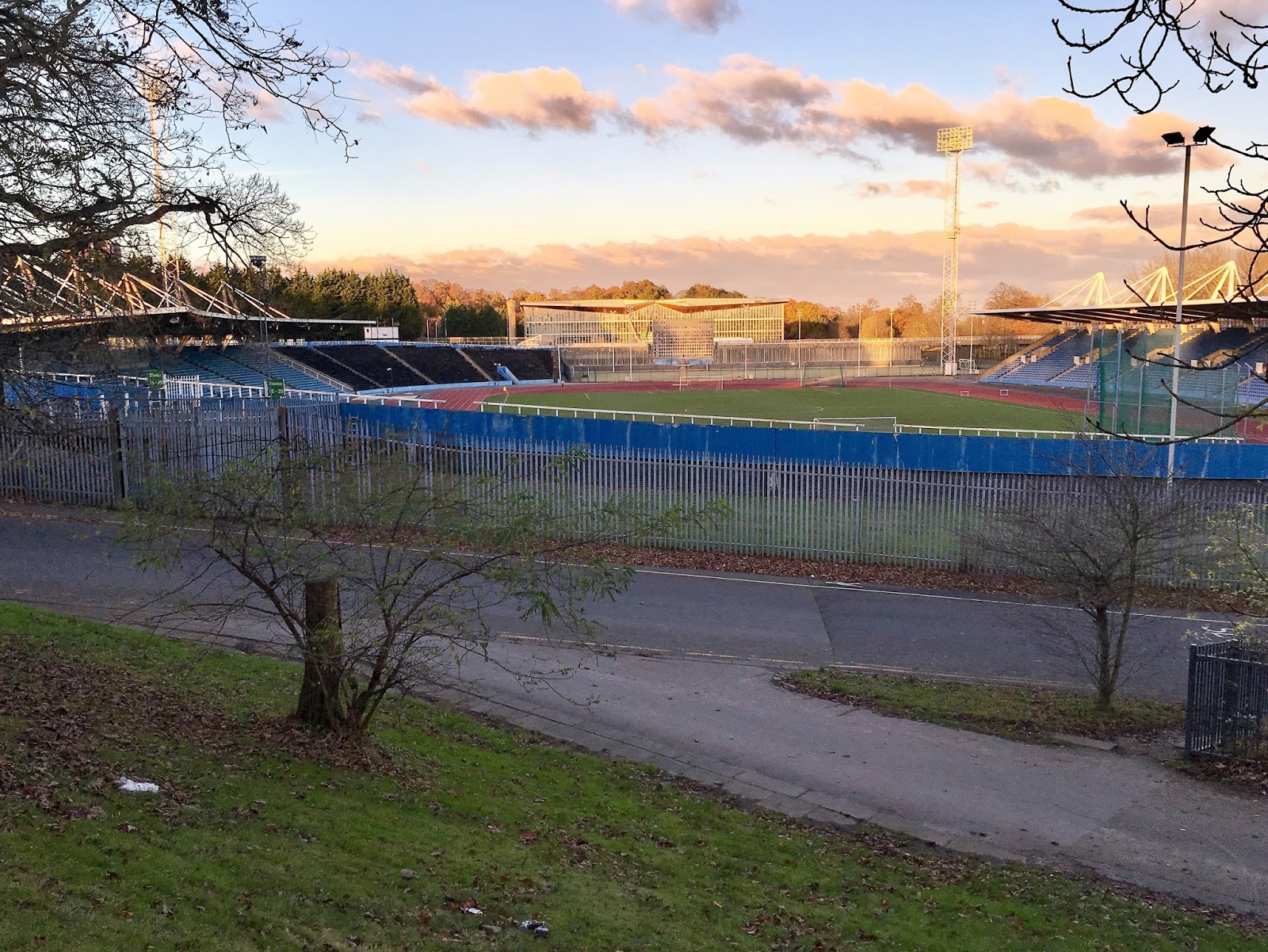
While the stadium was closed, it was easy enough to take photos from several elevated views. Its two cantilever stands faced each other across the track, while the ends were open. It sat in a natural bowl, and it became apparent how so many may have got a view of earlier cup finals.


The sports centre was a listed building, but it looked pretty ugly to me. It was more akin to something I imagined in an old communist state than belonging to the swinging sixties in London. The decade really did allow some monstrosities in construction.

My main point of interest was walking around the vast foundations that were still in place from the palace. I hoped that the rebuild could take place. It must have looked like an amazing site overlooking London on one side and the park and Surrey on the other.


The light was drawing in as I departed. I could have spent far longer just walking around and enjoying the views and scenery. As I headed for a bus to Brixton, I pondered just how so many people used to visit for those halcyon FA Cup Finals from cities hundreds of miles away before navigating their way across the capital.


It must have been something purely magical. Oh, to find that time portal! Instead, I headed to see the Jarvis family, including my Godson, at Hampstead CC before meeting Steve Barnes to go for a pint before the Haringey Borough v Thamesmead Town match.

It had been a packed, fun day out, which most can be in London if you put in the effort.

Tuesday 1st December 2020

Click here to read about a further visit as part of my 100-mile Sawasdee Cup Charity Walk late in 2020, as I called in on all the clubs in the top five tiers within Greater London to raise money for Junior Cricket Development in Thailand.