Sunday, 14 May 2017

Royal Wootton Bassett Town


Royal Wootton Bassett Town FC is a non-league football club from the town of the same name that is located six miles to the west of Swindon in Wiltshire, who were originally formed in November 1882.

The club initially played friendly games as Wootton Bassett Town FC, before becoming members of the Vale of the White League, followed by the Swindon & District League and then the Wiltshire County League. Games took place at ‘The Close’, where Tanner's Close is now in the town.


The club folded in 1908 because of constraints laid down by the league, before the opening of the Gerard Buxton Sports Ground led to the revival of the football club to become tenants along with the town’s cricket club.

The club joined the Calne & District League, going on to lift the title on three occasions, before re-joining an expanded Wiltshire League. At the end of the 1960’s, the league was restructured, with Bassett joining the Wiltshire Combination.


In 1976, a new Wiltshire County Football League was established with Bassett being placed in Division One, from where they suffered relegations on a couple of occasions, along with a successful promotion year.

Under manager Micky Woolford, the team won the league and promotion to the Hellenic League in 1987-88. Woolford’s side consolidated in the Hellenic League Division One before his departure in 1995. The club won the County Cup for the first time in 1999.


A year later, Bassett won promotion to the Hellenic League Premier Division before going back down to Division One West after the 2004-05 campaign. After a very poor finish, Bassett gradually rebuilt and eventually won promotion back to the Premier Division in 2009-10.

The club were demoted after just one season as their Gerard Buxton Sports Ground home on Rylands Way was deemed not to have the ground grading requirements. The 2012-13 season was the club's last at Rylands Way, with the team winning promotion once again to the Premier Division.


The first team decamped to the Corinium Stadium, the home of neighbours Cirencester Town, while the New Gerard Buxton Sports Ground was built on the outskirts of the town on Brinkworth Road, where it housed many sports on completion in the summer of 2015 for the Wootton Bassett Sports Association.

At the same time that the ground was completed, the club added ‘Royal’ to their name to reflect the royal patronage which was awarded to the town in 2011. Sam Collier was appointed as manager in March 2019, with Bassett having to deal with two seasons of abandonment, like their fellow clubs.


They returned with a midtable finish before an impressive fifth place followed in 2022-23, which was backed up by a playoff spot in 2023-24, which saw the side defeat Highworth United before losing their final against Cinderford Town. Jonny Aitkenhead was announced as the new team manager in May 2025.

Royal Wootton Bassett Town FC will play in the Hellenic League Premier Division in the 2026-27 season.

My visit

Royal Wootton Bassett Town 5 Burnham 1 (Saturday 8th October 2016) Hellenic League Premier Division (Att: 62)


With the day off work, I looked at several options to go to more than one match as the nearby Western League were doing a groundhop over the weekend with staggered kick-offs. While their earlier games were not the easiest to reach, the evening game at Calne was negotiable.

Swindon Town kicked off at lunchtime against Bolton Wanderers for Sky TV to fill in their schedule on this international break, with no fixtures in the top two divisions. Royal Wootton Bassett is located between Swindon and Calne, so their home game fitted the bill of filling in later that afternoon.


It wasn’t exactly ideal as the bus from Swindon would mean me missing the first half hour, but I could live with that. The number 31 bus dropped me at the end of Brinkworth Road before I completed my journey with a six or seven-minute walk.

On my arrival, the gate was open, so I paid no admission charge. The match programme was absolutely superb for £1.50. A bacon roll cost me £2, with a tea to wash it down, a further £1.20. I was immediately glad that I had made the effort.


The New Gerard Buxton Sports Ground was a really pleasant new build ground. One sensed that RWBT were a club on the up. The other facilities around the complex were also in use. It was obviously a facility appreciated by the local sporting community.

On my arrival, I was a little disappointed to hear that the game was already about over as a contest. Opponents Burnham were bottom of the table and having real problems. Bassett were 2-0 up thanks to goals from Stephen Olphert and Dale Richards.


The match was played in very good spirit with very little chat towards the referee, but I noticed his badge was of the Army when he came off at the break. There’s nothing wrong with a bit of fear and respect!

Bassett was an extremely well-organised club, with the team not too bad either. I felt for Burnham. Their young side tried to play proper football, and some of the lads had some real ability, but they were not all that keen on the gritty unseen jobs on the pitch.


Former Watford heroes and Joint Managers Gifton Noel Williams and Luther Blissett did their best, and I thought they were real gents, while being very frustrated. Burnham desperately needed a couple of grafters and experienced heads to help out the youngsters.

Stephen Robertson and Harry Spalding made it four in the second half. Cheyenne Cripps got one back for the visitors with the best goal of the day after a great passing movement. Lewis Thompson rounded off the scoring for Bassett


At full time, I walked into town in search of a good pub, ideally showing the England game. The only one with a TV served a poor pint, while the Angel looked the best, but it was full of modern families, no TV and expensive prices.

I’d expected Royal Wootton Bassett to be a very pretty town full of traditional pubs and pretty scenery, having seen it covered on many a sad news feature as military processions carried our fallen heroes through the town on their way from RAF Lyneham to John Radcliffe Hospital, Oxford. 


I found the town a bit of a disappointment as I hopped back on the 55 earlier than scheduled to head to Calne for the evening fixture.


Calne Town


Calne Town FC is a non-league football club from the town of Calne, which is located six miles east of Chippenham in Wiltshire. The football club was formed in 1886.

The club joined the Wiltshire League as founder members in 1894 while playing home games at the Recreation Ground in the centre of town before merging with another local side, Harris FC, to become Calne & Harris FC. Harris was the name of the bacon factory whose buildings dominated the town skyline.


Following World War II, the club emerged as Calne & Harris United FC, continuing to play Wiltshire County League football. In the early 1960s, the club changed titles to Calne Town FC and moved to a new Bremhill View ground, which offered scope for better facilities.

In 1985-86, a new committee was formed at the club in an attempt to bring a better standard of football to Calne. The move succeeded as they were accepted as members of the Western League for the 1986-87 campaign.


Expansion work beginning in 1991 saw a new clubhouse being added to the facilities at Bremhill View. In 1992-93, under manager Graham Fell, the team won promotion to the Premier Division of the Western League.

The side retained its status for three years, with managers coming and going before the club employed twenty-two-year-old Tommy Saunders as team manager. Saunders did a fine job in improving the team before he was offered the manager's job at Chippenham Town in February 1998.


The following season saw several players follow their former boss down the road to Chippenham. ‘The Lillywhites’ were relegated as a consequence to Division One in April 1999. The club tried to rebuild by using younger players but had a lucky escape when finishing bottom of the table in 2000-01 when league reconstruction saved a further demotion.

Gradually, the club re-established itself under manager Kelvin Highmore, who led the side back to the Premier Division in 2004-05, before he departed for pastures new. Highmore was succeeded by the team of Robbie Lardner and Simon Hillier, who took Calne to a fifth-place finish, the highest in the club’s history.


In May 2009, Lardner and Hillier stepped down to be replaced by the returning Highmore, who was joined by Tommy Dryden. They lasted until the end of the 2009-10 season when Calne finished bottom of the table and were relegated once again.

After further managerial changes, several of the younger reserve team players were given an opportunity in the first eleven, with their manager Simon Gardner taking over team affairs. Gardner later became the club chairman and appointed Neurin Jones as team manager.


The 2016-17 season was one of extreme disappointment after Dave Ferris took over from Jones in November, while Garry Murphy took over as chairman. Ferris was dismissed with two matches of the season remaining as the team finished second from the bottom of the table, with the club being reprieved from relegation.

The pairing of Clive McDaid and Ben Radford took over team affairs before Trevor Rawlings eventually took over the role. This was after the club was placed in the Premier Division of the Hellenic League in 2021-22 following a couple of abandoned seasons owing to the pandemic.

Calne were relegated to Division One of the competition twelve months later, finishing at the right end of the table for the following two campaigns. The club was placed in Division One of the Western League for the 2024-25 season under manager Craig Kent.

His side reached the playoffs, defeating Wells City before losing the final to Bradford Town.

Calne Town FC will play in the Western League Division One in the 2026-27 season.

My visit

Calne Town 3 Corsham Town 1 (Saturday 8th October 2016) Western League Division One (Att: 257)


My visit to Calne came about because the Western League had decided to run a groundhop weekend with many fixtures kicking off at staggered times. It was the international break for the top two divisions, which offered the potential for decent crowds to attend the matches.

It certainly worked for me. I was able to get to the Swindon Town v Bolton Wanderers match at lunchtime, followed by the majority of Royal Wootton Bassett Town v Burnham in the Hellenic League, before the 55 bus delivered me in Calne.


I had arrived early to ensure that I got a programme at the ground before going in search of some ale. I didn't bother with the North Star club outside the ground, which had been listed in the guides, and the one backing onto the ground was staging a kid's party.

Instead, I went back around the corner to the Jenny Wren, where both Wadsworth pumps were out of action. I sipped a bottle of Newcy Brown while taking in the closing stages of the desperate England v Malta game on TV before heading back to the ground where the crowds were massed on the far side.


Bremhill View was a tidy enough venue. The near side had a low terraced cover, with the far side being cramped and atmospheric with a low seated stand in the centre with changing rooms and a busy refreshment hut towards the corner flag.

Admission was a very reasonable £5, with the programme costing a further quid. I thought it was a tidy little ground with superb floodlights, which made the trees at the far end a very pretty image. I bought just about my first Bovril of the season for £1.


There were a few recognisable faces in the crowd from other matches as neutrals over the years, along with a real plethora of team jackets and hats. Scarborough Athletic fans Keith Crowe and Neil Daniels were in attendance and were doing the full Western League hop over the weekend.

The match turned out to be a decent local derby, which had apparently been very feisty in previous seasons. The visitors of Corsham Town went 1-0 up through Ben Pring before Mark Dolman levelled things up for the Lillywhites on twenty-one minutes.


Just before the half-hour mark, player-boss Neurin Jones made it 2-1 to the home side. There was no point trying to get served in what would have been a busy bar at the break. Instead, I took advantage of the great offer on half-price hot dogs for a pound. Some of the more frugal hoppers weren’t best happy having made their purchase at the higher prices a little earlier!

Oliver Webb made it 3-1 to Calne with half an hour left on the clock. They looked in control of the match when I had to depart to ensure that I caught the last bus to Chippenham. I missed a second goal for Pring that made the final score 3-2.


On arrival in Chippenham, I had time for a pint of the very quaffable Summer Lightning from the Hopback Brewery in the excellent Old Road Tavern, which was marked down for a return visit in the future.

At which point it was time for the rattler back to Paddington, and with the aid of a bus and the new night tube on the Jubilee line, it meant that I caught the end of the Football League goals on a rerun just before 2am when I turned the key to my door.


The people of Wiltshire whom I had come across were most amiable. All were friendly and helpful, helping to round off a wonderful day out.


Oxford City


Oxford City FC is a non-league football club from the city of Oxford who were formed in 1882. Playing in friendly games, the club reached the final of the 1902-03 FA Amateur Cup, losing to Stockton in a replay at Feethams in Darlington after the first game ended 0-0 at Elm Park, Reading.

City returned to the final of the same competition in 1905-06. On this occasion, they defeated Bishop Auckland 3-0 at Stockton before becoming members of the Isthmian League a year later.


In the seasons either side of World War I, the club played in the Isthmian League without winning any notable competition. In 1949, City lost its status as the major club in Oxford as neighbours Headington United turned professional, eleven years before they became Oxford United.

A runners-up berth in the league in seasons 1934-35 and 1945-46 were as close as the club came to further honours. Another second-place finish in 1977-78 encouraged the club to push forward following the transition to semi-professional football. 


City became a limited company in 1979 and appointed Bobby Moore as manager with Harry Redknapp as his assistant. Unfortunately for both parties, it wasn’t a success, with both big names leaving after a year. City were relegated to the second tier of the league in 1980, where they remained until the completion of the 1987-88 campaign.

This was the lowest point in the club’s history. Landlord Brasenose College evicted City from their historic White House Ground, which was close to the city centre, as the land was sold for housing. The club had no option but to resign from the Isthmian League.


After a break of two seasons, City were reformed and joined the Spartan South Midlands League, where they were placed in Division One, while playing their home games at Cutteslowe Park to the north of Oxford.

A third-place debut season promoted City to the Premier Division. In 1992-93, the team lifted the league title and regained their Isthmian League place as they started out in Division Three, as well as moving into a new home ground at Marsh Lane. Another debut third-place ending led to another promotion.


The 1994-95 season put City firmly back on the non-league map. A magnificent FA Vase run saw City defeat Herne Bay, Milton United, Peacehaven & Telscombe, Croydon, Taunton Town, Canvey Island, and Belper Town before going down 2-1 to Arlesey Town in the final at Wembley. To round off a few months, City also won promotion back to Division One of the Isthmian League.

A fourth successive promotion followed, although their spell in the top division only lasted two seasons before City suffered a relegation to Division One. Following a reorganisation of non-league football, that division became Division One North in 2002-03.


A sideways move to the Southern League Western Division came in 2004-05, which ended badly as the club was relegated back to the Spartan South Midlands League after just one season.

The club quickly recovered as that particular league title was lifted at the first attempt, as they won a place in the Southern League Division One South West. A fourth-place finish in 2007-08 led to promotion to the Premier Division, where City remained until the completion of the 2011-12 season.


City finished as runners-up and won promotion to Conference North. Even though the travel was problematic, the club gathered, and the team performed well, remaining in that division until a place became available through the geographical locations of other clubs in the newly named National League South.

An excellent spell during the 2016-17 season led to City ending the campaign in fourteenth position. Justin Merritt had been in charge of the team from May 2014 before he stepped upstairs in December 2016, when Mark Jones stepped into the breach.

The team finished in midtable for three seasons but claimed some Football League scalps in the FA Cup against Colchester United and Northampton Town before Mark Jones' departure in October 2019, to be replaced by interim bosses Justin Merritt and Andy Ballard.

The club continued to grow, adding age group teams of both genders as a couple of seasons were affected by the Covid-19 pandemic, as David Oldfield had a spell in charge of the team before being replaced by Ross Jenkins in March 2022, whose side reached the playoffs a month or so later.

Eastbourne Borough were defeated in a semi-final by Dorking Wanderers. The playoffs were again reached in 2022-23, with this time City defeating Worthing and then St Albans City to reach promotion to the top level of non-league football.

However, the National League proved a step too far for the Hoops as they went back down in 2023-24. 

Oxford City FC will play in the National League North in the 2026-27 season.

My visit

Oxford City 0 Wealdstone 3 (Tuesday 16th August) National League South (att: 303)


My good pal Tony Foster suggested that we head to Oxford, as neither had visited that particular ground or a City home game. Who was I to argue? I was picked up at North Harrow by my excellent driver on a very pleasant summer’s evening.

We arrived in good time and got parked up at a really impressive complex for sports that seemed to be well used. Admission was £12, with a programme costing another couple of quid. It was time to take in the surroundings.


Marsh Lane really was a neat ground, and a real credit to the club in how they’d developed it in a relatively short space of time. The far end goal and far touchline had terraced cover and open standing. The near side had a reasonably sized seated stand, with the changing room block towards the grounds entrance. The end nearest the gates was taken up by open flat standing and the clubhouse.

Going to buy a couple of teas, I couldn’t resist the excellently priced food on offer and availed myself of a really good cheeseburger for £2.70. It seemed a shame that not every club could offer such good value for money.


We settled against the railing on the halfway line on the far side between the benches. Wealdstone looked like a really decent side on my first look at them in their current campaign. Their away kit of all gold also looked the part. Manager Gordon Bartlett was away, so his assistant Scott McGleish had taken the reins.

After a tight first half of very few chances, the Stones started the second period with a flourish. In forty-seven minutes, a neat touch from new signing Elliot Benyon put in Danny Green to score, much to the delight of the usual decent-sized and vocal Wealdstone following.


Benyon missed a gilt-edged chance a couple of minutes later as he hit City keeper Jack Stevens with his free downward header. Around halfway through the second period, Stones doubled their lead. Matty Whichelow lay in wide man Omar Koroma, who cut inside before bending his shot into the far top corner of the net.

Five minutes later, it was 3-0. Koroma dummied a ball to Tom Hamblin, who set up Benyon, who scored at the far post. City tried their best until the end, but Wealdstone closed the game out in relative comfort.


By now, I was becoming excited. All the selections on my fixed odds coupon had come in, apart from the game at Doncaster Rovers, where the referee had been injured and the match delayed. We were back on the M40 before news came through on Twitter that Rovers had held out, and my bet would pay for a few matches over the following week or so.

It rounded off a really good night out in very decent surroundings.


Eastleigh


Eastleigh FC is a professional football club based in the town of Eastleigh, which is located between the cities of Winchester and Southampton in the south coast county of Hampshire. The football club was formed on the 22nd May 1946 as Swaythling Athletic FC, which was soon amended to Swaythling FC.

The meeting took place at the Fleming Arms public house and was led by Derik Brooks and a group of friends. Matches initially took place on Southampton Common and then at Westfield in Swaythling before moving to Walnut Avenue.


In 1950, the club joined the Hampshire League and moved to a new ground at Ten Acres in 1957. The club continued playing in the Hampshire League as they changed their name to Eastleigh FC in 1980.

The Wessex League was formed in 1986, and Eastleigh became a founder member. After a series of top-half finishes, the club made an inspired appointment when Paul Doswell became the team manager.


In 2002-03, ‘The Spitfires’ were crowned as Wessex League champions and promoted to the Southern League Division One East. Their debut season ended in a fourth-place finish, but the club struck lucky as non-league football was re-organised in the summer of 2006, with Eastleigh being placed in the Isthmian League Premier Division for 2006-07.

The club’s magnificent run continued as a new stand was built at Ten Acres, with the team matching the off-the-field work, reaching the play-offs, where they defeated Braintree Town before beating Leyton 1-0 in the final to win promotion to the Conference South.


Further ground developments took place in the summer of 2006 before Doswell departed in December of that year to be replaced by Jason Dodd, who lasted until the end of the season. A brief spell from David Hughes ensued before former Leeds United and Southampton striker Ian Baird came as team boss in October 2007.

His side just missed out on the play-offs in his first season in charge before they finished in third spot in 2008-09. However, they went out in the play-off semi-final on aggregate to Hayes & Yeading United.


After a couple of further seasons of mid-table finishes, Baird was replaced by Richard Hill, whose side reached the play-offs at the end of the 2012-13 campaign after the club had been bought by Bridle Insurance. It was to be disappointment once again as Dover Athletic ended the promotion hopes with a penalty shoot-out win in the semi-final.

Bridle Insurance vowed to have Ten Acres up to Football League standard within five years, as well as looking to improve the playing squad, partly through the Witney-based Glenn Hoddle football academy and their links with Oxford United, where they were primary sponsors.


Hill led Eastleigh to the Conference South title in 2013-14 and promotion to the then titled Conference League. The season saw the team reach the second round of the FA Cup in 2014-15 as Kidderminster Harriers and Lincoln City were defeated before the Spitfires went out away to Southport.

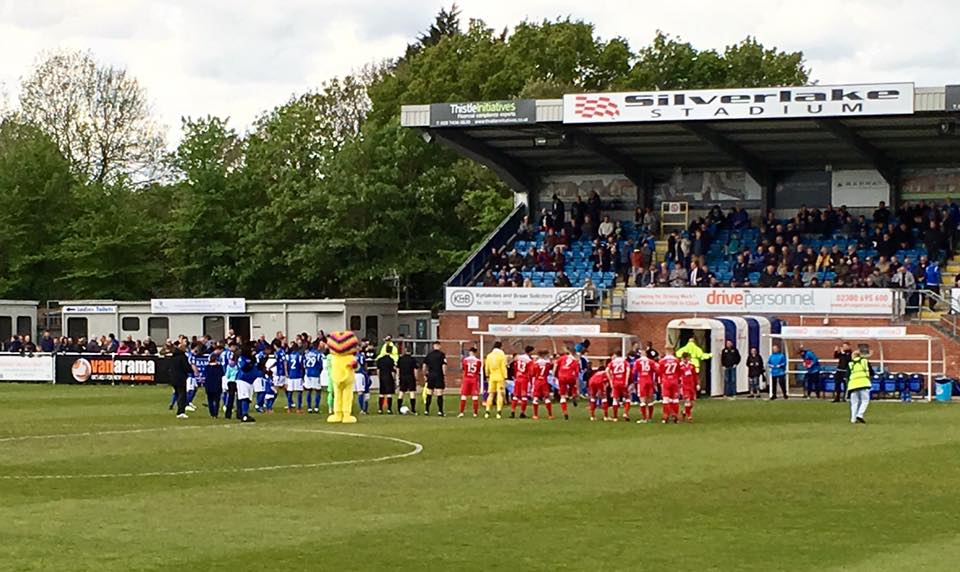
The good form carried on throughout the season as the Spitfires reached the play-offs, where they were defeated in the semi-final stage by Grimsby Town. Ten Acres was renamed The Silverlake Stadium in a sponsorship deal.


The Conference was renamed the National League for the 2015-16 season, with manager Hill resigning in September 2015 as Chris Todd took over team affairs, who took the side on another fine FA Cup run.

Wins over Bromley, Crewe Alexandra, and Stourbridge set up a third-round home tie against Bolton Wanderers, which attracted a record attendance to the ever-improving Ten Acres. The Spitfires went out 3-2 at the Macron Stadium following a 1-1 draw.


The team ended the season in seventh place, but a poor start to the 2016-17 campaign saw Todd dismissed, with former Tranmere Rovers and Rotherham United manager Ronnie Moore heading to the Silverlake as his replacement.

Moore lasted just three months before he resigned. Manager of many clubs, Martin Allen arrived from Barnet, lured by the potential at Eastleigh. His reign in the league was considered somewhat of a disaster as he was dismissed less than three months later.


Away from their poor league form, Eastleigh once again had a magnificent FA Cup run. North Leigh, Swindon Town, and FC Halifax Town were dispatched as the club reached the third round for the first ever time, eventually going out 5-1 at Griffin Park to Brentford.

Former manager Richard Hill returned to the club to try and change fortunes in February 2017 as the side ended the campaign in fifteenth position. Andy Hessenthaler was appointed as team boss in December 2017, prior to Chairman Stewart Donald leaving for League One side Sunderland.

Ben Strevens took over as manager in October 2018, as the side reached the playoffs thanks to the goals of Paul McCallum. Wrexham were defeated before Salford City ended their dreams of promotion in the semifinal clash. The side continued to perform consistently before Lee Bradbury was appointed manager in February 2022.

Former boss Hill returned again to the dugout in August 2023, after Donald had repurchased a controlling stake four months earlier, before giving way to Kelvin Davis the following February, who was replaced in September 2025 by Scott Bartlett, who lasted until February 2026, when Hill returned in interim charge before the appointment of Matt Gray.

Eastleigh FC will play in the National League in the 2026-27 season.

My visit

Eastleigh 1 Wrexham 1 (Saturday 29th April 2017) National League (att: 2,588)


It was the previous Tuesday night before I had any inkling that I’d be heading to the Silverlink Stadium on the final day of the National League season. My own club, Scarborough Athletic, was playing the semifinal of the playoffs, and if they won, I’d be heading up north at the weekend.

To add to the equation, I also had an advanced cheap flight to Glasgow and a hotel room that I’d booked before the cut-off fixtures had been decided. They had not been kind and were drifting from my list of favourites.


As it transpired, Boro were beaten 3-1 at home by Ossett Town. This opened up the chance to head to Eastleigh for their 12.15 start and then get to St Mary’s for 3pm for the Southampton v Hull City clash.

With my ticket booked online for the City away section, I managed to get some very good value South West Train tickets via Megabus. I bought my match ticket online for £12 and was all set to go on Saturday morning.


My train was at 9.39 from Waterloo. Despite a convivial Friday evening, I was in good form and really looking forward to my day out. I’d bought a return train ticket for the midweek Eastleigh home game against Macclesfield Town, which offered free admission. I didn’t go in the end as Hendon had a vital rearranged home game on the same date.

The service ran perfectly on time as I alighted at Eastleigh station at 11.00. I wandered outside and awaited the Bluestar 2 bus, which was also prompt. The driver explained that the St Nicholas Church stop near the ground was not available as the road was closed.


There was no need to worry as several Spitfires fans were on board. I jumped off by the main road by the Concorde Club and then walked down Stoneham Lane for five minutes to the stadium entrance.

I found the ticket office by the turnstile and picked mine up before being directed to the bar by a steward after picking up a programme for £3. There seemed to be a bit of confusion as to how to get to the bar, as I went through the turnstile before going through the club shop to find it.


It turned out that it was part of a new two-storey building which was opened for the first time. The shop was one more in keeping with a League club, and the bar was spotless. Unfortunately, the hand pumps were not yet in use, so I had to do with a bottle of Speckled Hen Gold.

Going by reactions, it would seem that the locals were very happy with their new facility. It would be open during the week for snacks as well as each Sunday for dinner. A club official was on hand to answer questions.


Outside, the ground was quite impressive too. The near end apparently had its roof removed. It was a modern terrace with the upper floor looking out to the pitch to enable the club to sell corporate packages. The far side had a low covered terrace. The near side with the raised seated Silverlake Stand flanked by open standing and club portakabins. The far end had a large semi-permanent seated stand.

Further plans for the stadium were unveiled in the programme. The next stage would be an extension of the Silverlake Stand as seated tickets had been at a premium. All in all, Eastleigh seemed a very well-organised and progressive club.


However, while all was good off the pitch, the product on it was abysmal during the first forty-five minutes. It was typical end-of-season fare from both sides. Neither goalkeeper really had too much to do with most of the play being scrappy and in the middle third.

Indeed, the highlight of the first half came when I purchased a massive feast of a Swiss Burger; a burger topped with cheese and mushrooms, chips, and a Bovril. It cost £6, but it was pretty good and filling. A nice touch was a bowl of raw onions for patrons to help themselves.


In the second half, I initially took up my previous position on the covered terrace near the halfway line. Almost immediately, the visitors took the lead to break the boredom. Iffy Allen’s shot was deflected across the box to Jordan White, who slotted home.

The goal awoke Eastleigh from their slumber. Sam Matthews came close with a curling effort from the edge of the box. Manager Hill brought on crowd favourite striker James Constable, and he got involved in some of the best moments.


With sixteen minutes left, he broke down the right-hand side to put in a low cross for forward partner Matt Tubbs to put away the chance. Wrexham claimed that Constable had fouled James Jennings to initially win the ball, but referee Carl Brook wasn’t convinced.

Constable later had an opportunity to fire home, but he dallied and instead tried to set up a teammate, only for the Red Dragons defenders to clear. By this point, I’d moved to the open terrace behind the goal to watch the last of my action, while keeping a close eye on scores elsewhere.


Scarborough’s local rivals, York City, were involved in a relegation scrap with Guiseley. Their games were changing scores, with no one quite sure who would be dropping to the National North.

With around six or seven minutes left on the clock, I had to depart to make sure that I caught the 2.02 bus from the Concorde Club to Southampton city centre. Reading the Eastleigh Twitter account, it transpired that I didn’t miss an awful lot.

The news from elsewhere was that a last-minute goal for Guiseley had relegated York. Meanwhile, my comment on Twitter that my game featured a very poor first half got a reply that if I thought that was bad, I should have seen the football under Martin Allen. The mind boggled!