Saturday, 11 October 2025

Arundel

Arundel FC is a non-league football club, formed in 1889, which represents the historic Sussex town of the same name. ‘The Mullets’ became a founder member of the West Sussex League in 1896, where they were placed in the Senior Division, remaining in the league until joining the Sussex County League in 1949.

The league title was won in 1957-58 and retained the following season before relegation to Division Two came in 1965-66. Promotion back to Division One was achieved twelve months later, before the side finished as runners-up in 1968-69. 

Another relegation came in 1975-76, but once again, the club’s top-tier status was regained after just one season, before dropping back down in 1982-83. Remarkably, one year later, Arundel was duly promoted, going on to become Sussex County League champions for a third time in 1986-87.

1997-98 saw the side drop down a level, before they recovered to win the Division Two title in 1999-00 to go back up. Vic Short was the team manager at Mill Road before he was replaced by Richard “Kilroy” Towers in 2007. His team ended up as league runners-up in 2008-09.

Gary Wheatcroft was appointed as manager in 2010-11 before being succeeded by his assistant, Simon Butler. The Sussex County League changed its name to Southern Combination, with Division One renamed Premier Division for the 2015-16 season, with Towers returning for a second spell twelve months later as team boss.

Arundel was relegated to the second tier of the competition in 2018-19 under Simon Hull. Jason Mines was appointed as manager in 2021, as his side finished consistently just outside the playoffs before reaching them in 2024-25, where they lost to Forest Row on penalties in the semi-final.

Mines departed to be replaced by Dickson Gill, who quickly departed.

My visit

Wednesday 5th March 2008

With a day off work and pleasant weather, I was ready to take full advantage of my pre-purchased Southern Rail Day Saver, which entitled me to unlimited travel for the day on their services for just a tenner. As ever, I had an itinerary in mind as I set off from Victoria Station.

First port of call was Arundel, which looked beautiful as I alighted and headed over the bridge over the River Arun, as I gave Leftfield’s Leftism a listen on my iPod. Life was good, looking up to the castle and wandering through the town towards the High Street and Mill Road.

The walk went past Arundel Museum and a bowling green, to the entrance to the pretty ground where the gates were open. A seated stand had a view of the castle behind it, up on the hill, while the opposite corner had a small cover for standing spectators, next to the clubhouse and changing rooms.

Once complete and having had a walk around, I headed back to the station and took the train to my next destination, the Nyewood Lane home of Bognor Regis Town.


Thursday, 17 July 2025

Witton Albion


Witton Albion FC is a non-league football club, founded in 1887, in the Cheshire town of Northwich by chemical workers. The team started out playing in the Northwich & District League, Crewe & District League, and the Cheshire League before joining The Combination in 1901-02.

Albion advanced to the Manchester League and then Division Two of the Lancashire Combination for the 1912-13 season, winning promotion as champions the following campaign. The club became a founder member of the Cheshire County League in 1919-20.

Wincham Park

Local derbies at the time against Northwich Victoria saw heated battles in front of packed crowds, with Witton going on to win the league crown in 1948-49 and 1949-50, before finishing as runners-up in 1950-51. These were halcyon days at the Central Ground, which was located, as the name suggests, in the centre of town.

A third Cheshire County League title followed in 1953-54. This was the same season as the team exited the FA Cup in the second round against Grimsby Town, with Witton also reaching the same stage a couple of seasons earlier, where Workington ended their run.

Central Ground. Photo: Andy Dakin.

The first round of the competition was reached in 1957-58, and then again in 1966-67, with Tranmere Rovers and Bradford Park Avenue being the victorious teams. The formation of the Northern Premier League in 1968-69 saw Witton overlooked, with Northwich Victoria's persuading other clubs not to admit their town rivals being thought to be the deciding factor.

This was at a time when former Manchester City star, Ken Barnes, managed the side, before another league runners-up place was accrued in 1978-79, leading to admittance into the Northern Premier League, finishing as runners-up in their first season.


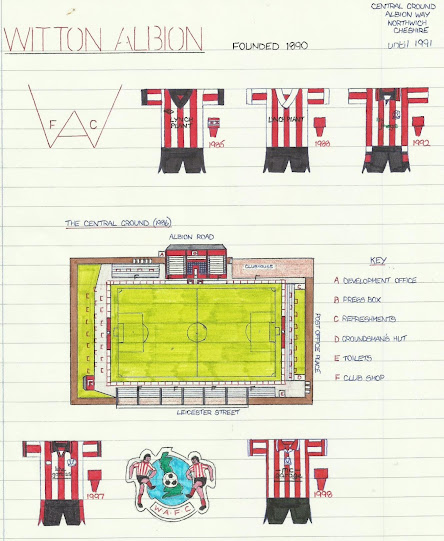
My drawing of the Central Ground, along with former club crests and team kits.
Click on the image to enlarge it.

The club sold their ground to Sainsbury and relocated to a new stadium called Wincham Park, which was opened in 1989. The NPL title was won in 1990-91, as well as the side reaching the semi-finals of the FA Trophy, where Kidderminster Harriers ended the dreams of a Wembley final.

Promotion to the Football Conference saw Albion join their rivals, Northwich Victoria. Albion reached the final of the 1991-92 FA Trophy but lost 3-1 to Colchester United at Wembley. 1992-93 saw Witton reach the semi-final of the competition once again, this time ending in aggregate defeat to Runcorn. 

Central Ground. Photo: Andy Dakin.

Meanwhile, the standard of league football proved to be too severe, as cash from the ground sale ran out, seeing the side relegated in 1993-94. The 1996-97 season saw a further demotion down to Division One of the Northern Premier League. A third-place finish was managed in 1999-00.

Promotion back to the Premier Division was won in 2003-04, where they finished as runners-up in 2006-07, a performance repeated twelve months later. Manager Jim Vince, who had done a sterling job, resigned to be replaced by Nigel Deeley. Gary Finley was soon appointed in his place. The team was relegated at the end of the 2008-09 campaign.

Central Ground. Photo: Andy Dakin.


Paul Ogden was appointed as team boss in May 2010, before in April 2011, Dave MacPherson and Brian Pritchard were appointed joint managers of the club for the remainder of the 2010-11 season. MacPherson left the club in the close season leaving Pritchard in sole charge.

The club was transferred to Division One North in 2010-11, winning promotion the following season via the playoffs with wins against Farsley and Curzon Ashton. The playoffs were reached again in 2012-13, with FC United of Manchester winning the semi-final tie.

Wincham Park

Anthony Sheehan replaced Pritchard, who had spent nineteen years at the club, in August 2014, with Tony Sullivan coming in as manager just five games later. The team was relegated at the end of the season, with Scott Dundas coming in as manager. Two months into the new campaign, he was replaced by Carl MaCauley.

The club upset some of their loyal supporters, allowing Northwich Victoria to share Wincham Park for the 2015-16 season. 2016-17 saw Witton promoted via the playoffs following victories against AFC Rushden & Diamonds and Spalding United. Vics returned as tenants in the summer of 2018. 

Wincham Park

The 2021-22 season saw the team relegated to Division One West of the NPL, with Jon Macken coming in as the new manager. After a couple of seasons just missing out on a playoff position, Ben Harrison was appointed as manager in August 2024. Vics had departed after a dispute several months earlier.

Witton Albion FC will play in the Northern Premier League Division One West in the 2025-26 season.

My visit

Saturday 1st November 1986

My visit to the Central Ground came about as I was in the car with my mate Gary Griffiths on the way to Chester v Walsall. We had already been to Edgeley Park, Stockport, which was locked with no access, and then Northwich’s Drill Field.

Central Ground. Photo: Andy Dakin.

It was a short distance to Albion’s home, which was another excellent venue, with a main stand and covered terracing opposite. There were plenty of standing options for spectators, along with crush barriers.

It didn’t cross our minds that both town centre grounds would no longer exist within a decade or so, as both clubs built new stadiums, one rather more successfully than the other.


Eastfield

Eastfield AFC, was an amateur football club, formed in 1952, which represented the large settlement connected to the south of Scarborough.

For many years, the club were one of the leading outfits in the Scarborough & District League at their Eastway home, picking up several honours along the way, including league title wins in 1981-82 and 1984-85. The second of which prompted the bold move to join the Teesside League for the 1985-86 season.

Scarborough FC also wanted their reserve team to play in the competition. However, reserve sides were against the league regulations, so the first incarnation of Scarborough Athletic was formed, with the Athletic Ground being the inspiration behind the name.

Craig Salt was the Eastfield player-manager.  Their first game was a 2-1 defeat at Darlington Railway Athletic. They remained in the Teesside League for six seasons, returning to the Scarborough & District League for the 1991-92 season.

The Strongwood. A base for former clubs.

Eastfield went on to win further titles in that league in 2005-06, 2007-08, and 2009-10. The club eventually folded in 2014, before other Eastfield clubs represented the area, using the Eastway Sports & Social Club as a base.

The Scarborough & District Football League discontinued after 126 years of competition, at the end of the 2023-24 season, a few years after the Sunday League also called it a day. A terrible shame and reflection on modern society, in the opinion of this author. There were divisions in both the Saturday and Sunday leagues when I left Scarborough in 1999.

My visit

Eastfield 2 Scarborough Athletic 2 (Wednesday 10th September 1986) Teesside League (att: c150)

A future Eastfield programme

Over the years, I played in many matches on several football pitches at Eastway, as well as cricket on a few occasions. Sunday League games were against Strongwood FC, with the team based in the pub next to the ground, which has also gone. The pitch for this game ran from east to west, with a rope along the nearside touchline for spectators to remain behind.

Back in the day, I was completely skint but eager to watch what promised to be a spicy local derby with much pride at stake. I walked from South Cliff over Oliver’s Mount and then the fields to Eastfield, which was over three miles, uphill and down dale. I was always fit at the time, helped by my financial irresponsibility.

How the Scarborough Evening News reported the game.

The match wasn’t a letdown as the report suggests. Plenty of niggle, aggression, skill, four goals and a sending off. It was embarrassing not to have any money to put into the collection bucket at half-time. Craig Short, at the start of a stellar career, was in the Athletic team.

I cannot remember if anyone gave me a lift back into town or if I walked back. The return match was also a classic on a cold day in icy conditions as Eastfield beat Boro 3-2, while Scarborough won away to Cheltenham on the way to the Conference title. Updated scores were announced to the decent-sized crowd.


Monday, 14 July 2025

Romford

Football clubs representing Romford go back to 1876, when Romford FC was formed. A fascinating history with ups and downs ensued since the pioneers lost 15-0 away to Darwen in the quarter-final of the FA Cup of 1880-81.

Apart from the Cup, friendlies were played until the club joined the newly formed South Essex League in 1896. Another club, Romford United, split away in 1909, playing home games over the road from their old friends. The originals had one disastrous season competing in the Southern League.

Main Stand, Brooklands.

Their general lack of organisation saw them expelled from the South Essex League in the 1910-11 season and subsequently disbanded, while rivals United changed their name to Romford Town and joined the Athenian League for two seasons. Town folded in December 1910.

Another club, Romford Town Thursday, played on Thursday afternoons at Brooklands, a ground formerly used by the reserve team of Romford FC. A new club, the second version of Romford FC, took up occupancy of the ground and joined the London League in 1929, joining the Athenian League two years later. 

They became champions in 1935-36 and 1936-37 before transferring to the Isthmian League following World War II. In 1948-49, Crook Colliery Welfare were defeated at Upton Park in a replay after a drawn game at Roker Park for the ‘Boro’ to reach Wembley in the final of the FA Amateur Cup.

View from the Main Stand at Brooklands,
also home to the Romford Rockets speedway team at the time.

Bromley won the final 1-0 in front of 100,000 fans. By then, Romford had also reached the first round of the FA Cup a few times, going out to Folkestone, Brighton & Hove Albion, and Yeovil Town. The club moved to Division One of the Southern League for the 1959-60 season.

Promotion was won in their first season in new surroundings, with the club reaching the second round of the FA Cup on several occasions. In 1960-61, Sutton United were defeated in round one before Northampton Town proved too strong. 1961-62 saw Watford win at Brooklands Stadium after a victory over Walthamstow Avenue.

First round defeats followed against Enfield, Luton Town, and Wimbledon, the last of which came after the 1966-67 Southern League title being won. It was around this time that the club entered the ballot hoping to be elected to the Football League, which proved unsuccessful.

Brooklands in the 60s

1970-71 saw Gillingham leave Brooklands with a win in the second round of the FA Cup before Boro were relegated from the Premier Division to Division One of the Southern League in 1974-75. The club had invested heavily in their home ground in the hope of making the step up, ending up in financial difficulties through it.

Brooklands was sold in 1975, with the club remaining there for another two years. With no new ground being started, Romford shared venues before resigning from the league in the summer of 1978, as the club closed down.

In 1992, a new incarnation of Romford FC was created, becoming a member of the Essex Senior League as a tenant of Hornchurch FC at Bridge Avenue. In 1995-96, the league title was secured while sharing with Ford United at Rush Green, followed by a merger with Collier Row FC to become Collier Row & Romford FC.

Romford's plans for Westlands.

This controversial move saw the amalgamation play at the Sungate ground and take up Row’s place in Division Two of the Isthmian League, by-passing a division along the way. The divisional title was won in 1996-97, with the club dropping Collier Row from their title, leaving those involved needing to set up a new incarnation of that club.

The team was relegated to Division Two in 2000-01, and with Sungate lacking in facilities, Romford often had to borrow grounds elsewhere to fulfil fixtures, as the entry into “my visits” below will verify. The club eventually vacated the ground in December 2001 before returning to Rush Green in 2002.

This was after the club had been relegated to the Essex Senior League. Paul Martin became manager during the 2007-08 season, as the club moved to become the tenant of Aveley FC at Mill Field. Boro lifted the league title in 2008-09, enabling them to rejoin the Isthmian League as a Division One North member. 

Rookery Hill, Corringham. One of Romford's several tenancies.

In 2009, the club had high hopes of a new ground as permission to build a new stadium on the Westlands Playing Fields on London Road was granted. Finances would prove to be the issue. With a sparse playing budget, the Boro managed to stay up for over a decade.

Another move followed in 2012, this time to Ship Lane, Thurrock. They then headed to Rookery Hill, the home of East Thurrock United at the time, to share facilities in 2018. More controversy arrived in the shape of Glenn Tamplin, who became a major investor and manager of the club in November 2019.

Lots of new players were signed on big wages, this after the club had moved once again, this time as a tenant of Brentwood Town FC. Tamplin departed after two seasons were abandoned by the worldwide pandemic, with Steve Butterworth taking over as manager.

Mayesbrook Park, Barking.

This was while Romford had moved into Mayesbrook Park to share with Barking FC. The team was relegated back to the Essex Senior League in 2021-22. Dan Spinks became the manager in March 2023, while in November of the same year, the Boro returned to the now vacant Rookery Hill.

The 2023-24 season proved to be special in the history of the club. A run in the FA Vase saw a semi-final victory over Lincoln United, which led to a 3-0 win at Wembley against Great Wakering Rovers. The playoffs were also reached, where Sporting Bengal United ended hopes of promotion after Barking had been defeated in the semi-finals.

FA Vase winners 2023-24.

The move to East Thurrock proved to be unsustainable, so the club returned to Mayesbrook Park, while manager Spinks and most of the squad departed, with Kris Newby being appointed as the new manager. Meanwhile, local MP, Andrew Rosindell continued to champion the cause to find the club a permanent home in his constituency.

Romford FC will play in the Essex Senior League in the 2025-26 season.

My visits

1999-00 Season

I had moved to live and work in London, and on occasional days off work, I would venture out and try to see parts of the capital I hadn’t previously visited. This would invariably include visiting football grounds far and wide on a one-day travelcard.

With my Non-League Annual and an A-Z map as companions, I would plan trips. On this occasion, I decided that Collier Row might be a nice idea, so I took what I presume was the 247 bus from Romford and getting out five-minutes short of the ground.

My drawing of Sungate, with some old Romford team kits.
Click on the image to enlarge it.

I cannot recall everything, but the drawing of the venue shows that I must have taken photos or notes of some kind. I headed on once I had my look and caught another bus to Barkingside to catch the tube home.

Later, towards the end of the season, I decided that a midweek fixture, which could well have been a Thursday night, fitted the bill. It wasn’t the easiest journey, needing a long tube ride and then a bus, which was at least half an hour in duration, especially as people were returning from work.

Arriving at the ground in plenty of time before kick-off to have drinks in the clubhouse, I was dismayed to be greeted by a sign announcing that the game had been moved to the home of East Thurrock United. I hung around for a few minutes in case anyone else was coming to the game who might have offered me a lift.

Wednesday 27th September 2007

Again, I was out and about, this time taking stadium photos with my new digital camera. Curiosity got the better of me after leaving Hornchurch’s home, taking a bus to Romford, and then another to Collier Row.

The ground was virtually raised to the floor, with just ruins of stands remaining from the view, I managed from the gates of a car mechanics yard. Once more, I headed back to the tube, disappointed.


Sunday, 6 July 2025

Penrith

Penrith AFC, from the market town of the same name in Cumbria, has a rich history since its formation back in 1894, starting life competing in local competitions before joining the Carlisle and District League, which the side won on several occasions.

The North Eastern League was joined in 1907-08, before the ‘Bonny Blues’ became a member of the Northern League in 1948-49, finishing as runners-up in 1961-62, which was backed up by third place the following season, under manager Alan Ashman, before the team returned to their usual bottom half finishes.

In 1981-82, Penrith went on an FA Cup run, leading to victory over Chester City at Southend Road in round one proper, before bowing out away to Doncaster Rovers at Belle Vue. 1983-84 saw Hull City come to town in the first round and leave with a victory, before Burnley were entertained, handing out a thumping at the same stage.

Where Penrith's Southend Road ground used to be

Those two defeats came after Penrith had become a founder member of the North West Counties League in 1982-83, where they were placed in Division One of the competition. A runners-up place in 1983-84 was achieved before the club joined Division One of the Northern Premier League in 1987-88.

The team was relegated in 1989-90, rejoining the NWCL as a Division One side, before moving back to the Northern League in time for the 1997-98 season. They finished sixth on their return before being relegated to Division Two in 1998-99. The title was won in 2002-03 to return to Division One.

They were relegated the following season. A change of name to Penrith Town was adopted in 2007, before returning to their former title a year later after merging with local side Penrith United. Around the same time, the Southend Road ground was earmarked for development by the local authorities.

A new stadium at Frenchfield on the edge of town was moved into in 2009, with businessman Ges Ratcliffe becoming the owner, making the club a private company before later returning it to its members, as a proper youth set-up was developed. Long-serving manager, David Heslop, resigned before the ground move after six years in charge.

Richard Prokas and James Tose became joint-managers before the side was led for a short time in 2012 by Brian Williams. He was replaced by Matt Henney. The club would later go through three managers in three seasons: Jim Nicols in 2016-17, Kyle May in 2017-18, and then Andrew Coyles in 2018-19.

All found it difficult to take the side towards the top half of the Division One table, while retaining their status at the same time. David Hewson was replaced in the job by former Jamaica international Chris Humphrey in 2021, before the appointment of Darren Edmondson in May 2022.

Edmundson was lured away to return to his former club, Workington, in May 2025, leading to Nicols’ return for a second spell in charge of the team.

Penrith AFC will play in the Northern League Division One in the 2025-26 season.

My visit

Southend Road

Saturday 26th October 1987

A stop in Penrith after seeing Scarborough get a good hiding on the pitch, losing 4-0 away to Carlisle United, nearly saw me and my mates receiving something similar while simply fancying a few beers and a mini pub crawl.

There wasn’t an ounce of malice on our minibus, but a group of locals seemed to think we were fair game. They were not following us to a few pubs to invite us home for tea. Between drinks, I nipped away to have a look at the Southend Road ground. Someone might have joined me. I honestly cannot remember.


My drawing of Southend Road, along with some older Penrith kits.
Click on the image to see them closer up.

I remember it being open, as was the clubhouse, which would have been a better option for a drink in hindsight. It had a wooden seated stand along one side and a cover for standing spectators opposite. The rest of the ground consisted of open, flat standing areas.

Thinking back. If we got the reception we did, what must the town have been like when Hull City and Burnley visited? Maybe that’s why the local lads were so game? It was said that there had been a race meeting at Carlisle, and it wasn’t unusual for trouble with visitors to break out. Maybe that was the reason behind our welcome?

I never got to the new ground with Scarborough Athletic, with the images on this page being sourced online.


Abingdon Town

Abingdon Town FC is a football club from the Oxfordshire town of the same name that can trace its roots right back to 1870, when they were formed as Abingdon FC. The club became a member of the Oxford & District League in 1892, absorbing St Michael’s FC in 1899.

Consecutive league titles followed shortly after, before the ‘Abbots’ joined the Berks & Bucks League, where they competed for just one season before choosing to play in the West Berks League. Another change of competition followed in 1904, seeing the club join the Reading Temperance League.

On joining the North Berks League in 1919, Abingdon were crowned as champions in their debut season, which was backed up by further success in 1922-23, as the club settled into their new Culham Road home ground. Whereupon the club moved to the Reading & District League, adding ‘Town’ to their name in 1928. 

They finished third in Division One in 1931-32 to win promotion to the Premier Division. After finishing at the bottom of the table for a third time in 1936-37, Abingdon joined the Oxfordshire Senior League for one season before returning to the North Berks League.

The moves around the competitions continued after World War II, as Abingdon returned to the Reading & District League, finishing as runners-up in 1946-47. The Spartan League was joined for the 1950-51 campaign before the club became a founder member of the Hellenic League in the summer of 1953.

1956-57 saw the Abbots crowned as champions, a feat they repeated in 1958-59, and again in 1959-60. They were relegated in 1965-66 before regaining their Premier Division status a year later. The runners-up position was achieved in 1970-71, which was repeated the following season.

My drawing of Culham Road and some Abingdon Town kits
To enjoy a closer look, click on the image.

Relegation followed in 1974-75, which was put right by another immediate return. A fourth league title was won in 1986-87, backed up by a second place twelve months later, as Abingdon moved to the Premier Division of the Spartan League, winning its title at the first attempt.

This was rewarded with a place in Division Two South of the Isthmian League, winning promotion to Division One in 1990-91, where the team remained until they were relegated at the end of the 1997–98 season. Another demotion, down to Division Three, followed in 1998-99.

Division Three became Division Two after the Isthmian League was reorganised in readiness for the 2002-03 campaign. Despite finishing in seventh place in 2004-05, Town dropped down to the Premier Division of the Hellenic League, where the team struggled for several seasons.

Bottom place in 2014-15 resulted in a drop of two tiers, down to Division One of the North Berks League. After being inactive for a year, the Abbots returned to Division Two East of the Hellenic League in 2017-18, moving up to Division One East a season later, rather than competing against mostly reserve sides.


Abingdon Town's manager, Tranell Richardson, caused a stir in December 2019 when his team shipped in eight goals before half-time against local rivals Abingdon United. They left the ground and refused to continue, with the team boss resigning the following day. Byron O'Regan was appointed to bring stability to the club.

After two seasons of abandoned competitive football owing to the worldwide pandemic, Town withdrew from the Hellenic League after failing to reach an agreement with the new owners of the Culham Road ground. They changed their name to Abingdon Abbots, joining Division One of the Oxfordshire Senior League for the 2022–23 season.

Promotion to the Premier Division was achieved in 2023-24, as the club changed back to being called Abingdon Town, finishing sixth in 2024-25 under manager John Beames. 

Abingdon United will play in the Oxfordshire Senior League Premier Division in the 2025-26 season.

My visit

May 1999

I had not long moved to London and secured a job at Lord’s Cricket Ground working for the MCC. My mate Steve had moved from Scarborough with his girlfriend Sarah and was living in Radley, south of Oxford. I went to stay with them for a couple of nights, discovering some new places.

It was a Bank Holiday weekend, so on Monday we decided to walk to Abingdon to have a game of pitch and putt at Abbey Meadows by the River Thames, which took around half an hour, passing some interesting-looking pubs along the way. Once we had finished, I said I’d like to look at the football ground. 

The venue was open, and it seemed like a decent set-up, having stands on either side of the pitch and a sizeable clubhouse. We took the bus into Oxford once we had finished for a look around before I caught the service back to London.

Somewhat remarkably, I never got to see a game there despite visiting times, and even more so, I never went to look at the Abingdon United ground, despite catching a bus into town from outside it on several occasions.

I didn’t have my camera with me on my visit in the days before smartphones and their images being instantly available, so those on this page have been sourced online.


Wednesday, 18 June 2025

Corinthian

Corinthian FC is an amateur football club, formed in 1972 by RJ Billings snr, based close to the Kent town of Sevenoaks, to provide a place to play the game in a safe environment while teaching players the principles of its founder.

Gay Dawn Farm welcomed many big-name clubs in Corinthian’s first decade. With Tony Sitford installed as manager, the side progressed from youth football to the Southern League, becoming members of the Southern Division in 1985-86.

Because the ‘Hoops’ retained their amateur status, they struggled to attract players, leading to them dropping back down to the Kent League after the 1990-91 season. In 1998, the club voluntarily dropped down to Division Two, while the lower levels of the club were rebuilt.

They re-established their youth set up and fielded five teams by 2008, of different levels and ages. A liaison with Welling United was created, integrating a senior side, progressing to the Suburban League South Division in 2009-10.

The Kent League was rejoined, which was renamed the Southern Counties East League in 2013. Back in 1987-88, the side reached the fifth round of the FA Vase, going out to Clevedon Town. Michael Golding was appointed as manager in January 2015, as Corinthian reached the fourth round in 2016-17 when Exmouth Town ended the run.

Corinthian were league runners-up in 2018-19, before going on another big FA Vase run the following campaign. This led to a semifinal tie at Gay Dawn against Hebburn Town, which ended in defeat on penalties and thwarting any dreams of a Wembley appearance.

This was during the first of two abandoned league seasons owing to the worldwide pandemic. Non-league football was restructured when normality returned, with Corinthian’s previous efforts being rewarded in promotion.

The Hoops were placed in the South East Division of the Isthmian League for the 2021-22 season, finishing eighth, before being relegated in 2022-23, and returning to the Premier Division of the Southern Counties East League.

The playoffs were reached in 2023-24, leading to a win against Faversham Town, before Erith Town won the final on penalties to deny Corinthian promotion. Keith McMahon was appointed as manager in May 2025, replacing Golding, who had enjoyed ten years in charge of the side.

Corinthian FC will play in the 

My visit

Corinthian 2 Erith & Belvedere 1 (Saturday 3rd July 2021) Pre-Season Friendly (att: c30)

Covid restrictions were gradually being relented, with some rules and regulations to be adhered to. I wanted to get out and about on my weekend away from work and generally have some fun in what had been a difficult period for many.

As is often the case, I changed my mind about my destination several times in the days before the game. Ideally, I wanted an early kick-off and a new tick. I'd initially set off towards Ampthill v Totternhoe, but I forgot the Jubilee line was up the creek, so I headed to Victoria for the train to Longfield.

I was rewarded by a feisty encounter with plenty of skill on display as the newly promoted hosts came from behind to defeat a decent pacey Deres side, who had a most entertaining keeper, who certainly added to the visit.

An interesting 1.5-mile walk along Valley Road and then Rectory Road, with cars occasionally going past, uphill without footpaths, once out of Longfield to Gay Dawn Farm, a lovely venue out in the sticks, with the roar of engines from racing at Brands Hatch in the background.

Everything about the venue smacked of quality at Corinthian Sports Club. The warm welcome and plush upstairs bar were appreciated after the walk. It had indoor and outdoor 3G pitches for small-sided games, a second floodlit full-sized pitch, and a 9-hole golf course.

I spent most of the match in the raised seated stand straddling the halfway line once I had paid my £5 admission fee. There was a cover behind the goal at the entrance end of the ground and raised banking along the far side near the changing rooms.

I met a fellow hopper, a Boston United fan, as we reminisced about the good old days when the Pilgrims and Scarborough were traditional rivals. A smashing fella, we covered most sporting issues and walked back to the station together post-match.


I had fancied taking in one of the games in the mini diversity tournament at Punjab United, over in Gravesend, but I couldn't get a phone signal to order an Uber cab. A bit of a shame as I knew my opportunities for new grounds were running out before my imminent move to Thailand.

I must have had a good afternoon as I broke my code and went to the pub to watch Ukraine v England in the Euros. It proved an inspired decision, meeting my local mates drinking fine ale, watching a great win and then listening to top tunes. A belting day all round.